Brand
Barco
Cinema projection, from the company the world’s theatres trust. Ninety years of Belgian imaging.
Authorized Dealer — Scottsdale & Tempe, Arizona
Trade-in credit toward new purchases · Full installation and calibration · Walk in during business hours or book ahead
See what's on demonstration now ↓Barco was founded on 12 September 1934 in Poperinge, Belgium, by Lucien De Puydt and American engineer Frank Bowens as the Belgian American Radio Corporation — a Flemish radio manufacturer assembling receivers from parts imported through the United States. Ninety-two years later the company is a global leader in professional visualisation technology headquartered in Kortrijk, with three core markets: healthcare, enterprise, and entertainment. The entertainment division builds the DLP cinema projectors that sit in the majority of the world’s commercial theatres.
Barco Residential is not a separate company or a licensing arrangement. It is the residential-market arm of the same engineering group that builds the commercial cinema projectors. The Series 4 platform that runs in the multiplex is the same Series 4 platform that runs Freya and Nerthus in a private cinema. The Pulse electronics and software architecture that runs Barco’s laser-illuminated exhibition projectors runs Bragi, Balder and Heimdall in the home. The engineering underneath a Barco Residential projector is not a scaled-down consumer version of professional technology — it is the professional technology.
Cinema projection, engineered for the room the film was made for
The premise Barco brings to residential projection is that the picture on a private cinema screen should look like the picture in a properly calibrated commercial theatre, because the picture in a commercial theatre is the reference the film was mastered to. Every other consideration in the residential category — chassis size, form factor, mounting flexibility — is subordinate to that.
Four light-engine technologies run across the current Barco Residential range. Nerthus, the flagship, uses native 4K DLP Cinema chips from Texas Instruments — the same imaging device used in commercial theatres — with the Barco Alchemy Integrated Cinema Media Processor X for DCI-compliant playback. Freya and Freya+ are also native 4K DLP on Series 4, tuned for high-end home cinema. Bragi runs on the newer high-lumens-density RGB LED engine, delivering wide P3 and DCI colour on the Pulse platform with no laser and no cooling penalty. Heimdall and Heimdall+ carry RGB laser illumination with HDMI 2.1 for the workflows that mix cinema, gaming and 4K HDR streaming in one room.
Most models are offered in a native Cinemascope variant with wide-format optics — the 2.39:1 image that films are actually released in fills the screen without letterboxing and without electronic scaling. This is the detail that separates a Barco cinema installation from a large-screen television: the film is displayed at its native aspect ratio at the native resolution of the imaging device, without the scaling artifacts that appear when a 2.39:1 image is displayed on a 16:9 chip.
The Barco Residential line at LMC
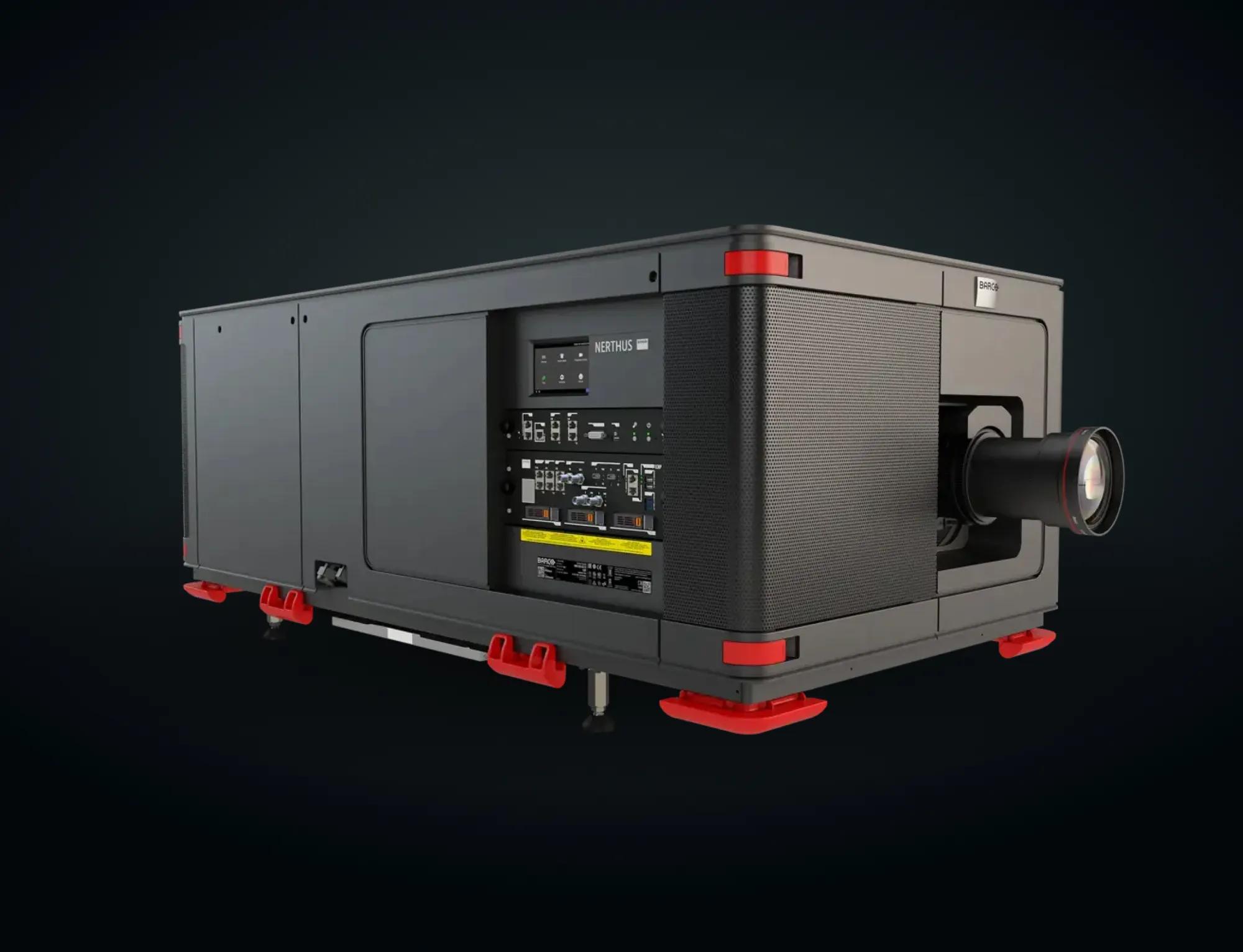
LMC carries the current Barco Residential range on the home cinema projectors page. Nerthus is the flagship — Barco’s highest brightness and contrast, thirty-two thousand lumens, one hundred per cent Rec.2020 colour gamut, Barco Alchemy ICMP-X for full DCI-compliant Digital Cinema Package playback. It is specified for the largest private cinemas and reads the same DCPs a commercial exhibitor would receive from the studios.
Freya and Freya+ are the workhorses of the high-end residential range: native 4K DLP on Series 4 with the Alchemy ICMP-X, tuned for dedicated theatres. The Freya CinemaScope variant carries native wide-format optics for 2.39:1 screens.
Balder is Belgian-built with an aluminium and magnesium chassis, custom aspherical glass optics, and a single laser engine derived from the Loki platform. Bragi is the RGB LED design — high-lumens-density LED illumination on a 0.9-inch DLP chip delivering 5,120 by 2,160 pixels in 2.37:1, with the same optical core Balder uses. Heimdall and Heimdall+ carry RGB laser with HDMI 2.1, with the Heimdall Cinemascope variant for wide-format installations. Njord covers large-screen installations and higher-ambient-light environments; Medea covers small-to-medium media rooms with a laser engine and Pulse electronics.
Barco Freya in the Grand Cinema Suite
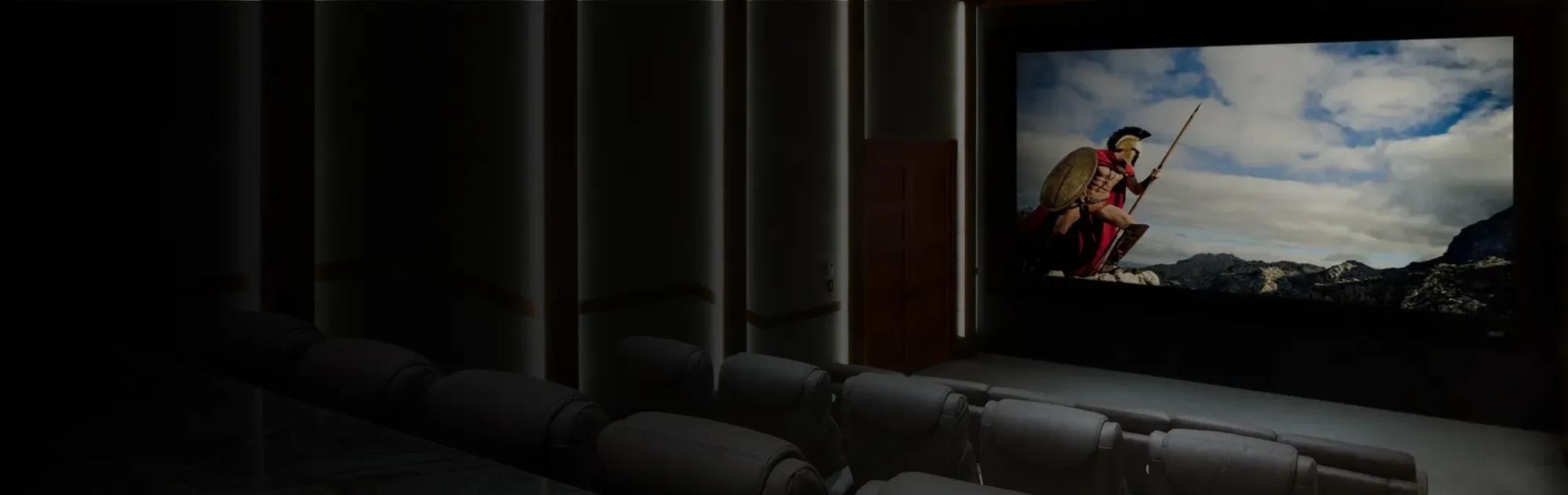
Barco is on demonstration in the Grand Cinema Suite at LMC Scottsdale — the room LMC built around the McIntosh XRT2.1K line array system, and the room where the projector has to hold up against reference-tier everything else in the signal chain.
The XRT2.1K sits at the front of the room in a pair of vertical line arrays, eighty-one drivers per column, driven by McIntosh MC2.1KW monoblocks at two thousand watts a channel through a tri-chassis design, with MC1.25KW monoblocks handling supporting channels — every one of them using the McIntosh Autoformer, so full rated power reaches the loudspeaker at two, four or eight ohms alike. Sonus faber Arena in-walls carry the surround and Atmos height channels, tuned to the Voice of Sonus faber transducer set. REL Carbon Special Black Label subwoofers run in line arrays of up to three per side. Trinnov’s Altitude32 processor decodes and corrects everything — Dolby Atmos Home at the full 24.x.10 count, DTS:X Pro at 30.2, with the Optimizer and patented Remapping steering sound elements to the placements the mixer intended.
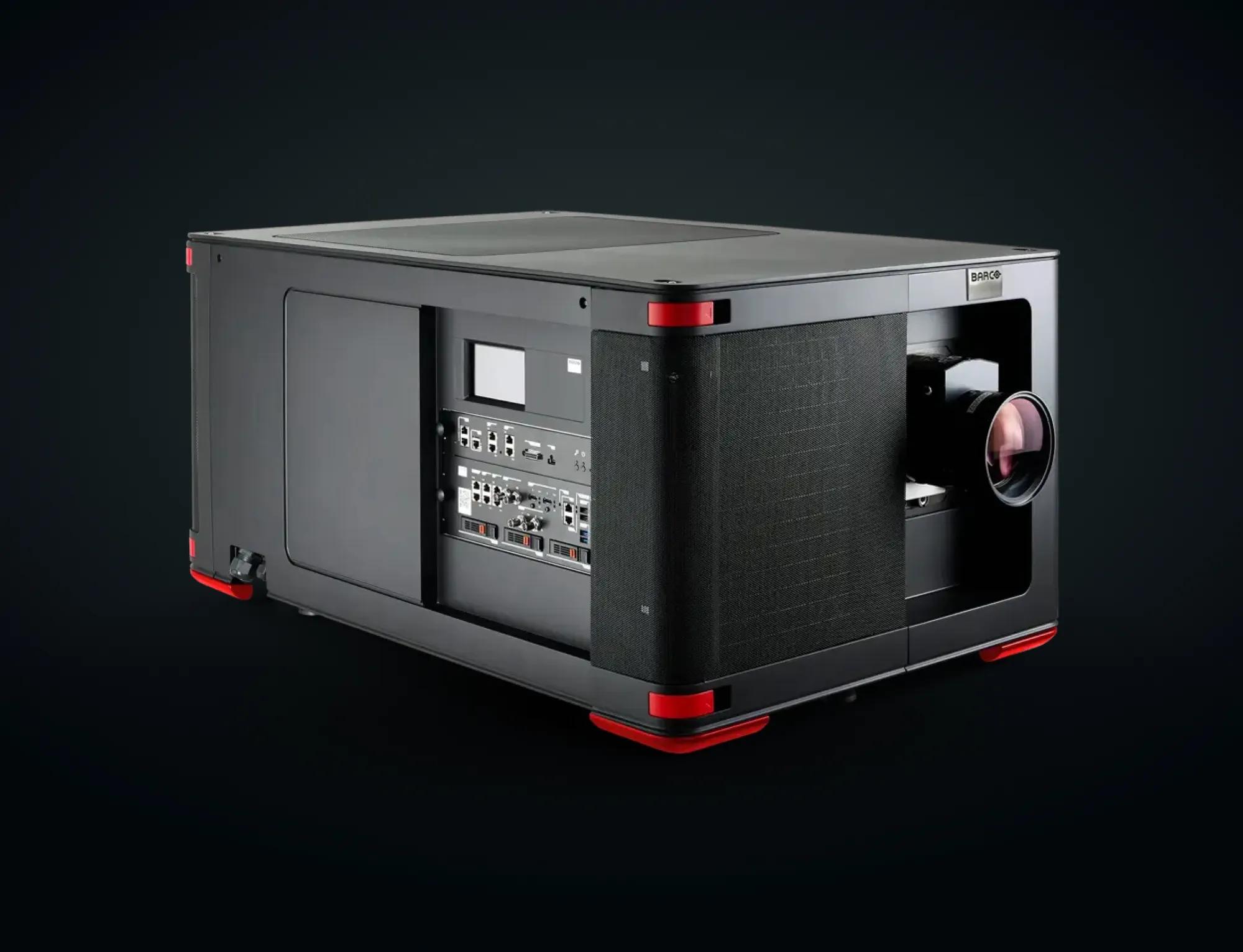
The projector doing the picture in that system is the Barco Freya. Native 4K DLP at 4,096 by 2,160, solid-state RGB laser illumination, DCI-compliant with a Barco Alchemy ICMP-X media server capable of reading the same Digital Cinema Packages a commercial exhibitor would receive. What that means practically is that the reference for the image in the Grand Cinema Suite is not the consumer 4K UHD Blu-ray specification — it is the DCI specification the film was mastered to. It is the difference between watching what the film was compressed for and watching what the film actually is.
LMC as a Barco Residential dealer
LMC is a Barco Residential dealer because a projector at this level is not a component the client selects from a spec sheet — it is a system that begins with the throw ratio, the ambient light budget, the screen material, the acoustic transparency of the screen if the loudspeakers sit behind it, the room ventilation for the projector’s thermal envelope, and the calibration standard the room is built to. All of those are architectural conversations, not shopping conversations, and they happen on site with an installation partner qualified to specify the Alchemy ICMP-X media server and the network topology behind it.
What the Grand Cinema Suite in Scottsdale demonstrates is what a Freya installation actually looks like — the light output the projector delivers into a specific screen at a specific throw, the black level the room design supports, the calibration standard the picture is held to across sessions. The specification conversation for a new Barco project begins from that demonstration and moves to the client’s room drawings, which is where the model choice — Nerthus, Freya, Balder, Bragi, Heimdall, Njord or Medea — is actually made.
Where to start
The Grand Cinema Suite is the production Barco demonstration LMC operates, and it is the honest place to begin. Bring a scene from a film released to commercial theatres in the last three years, ideally one you have already seen in a proper cinema. The Freya reads the same Digital Cinema Package a commercial exhibitor would receive, and the comparison the projector is designed to survive is not against a consumer 4K Blu-ray — it is against your own memory of that film in a properly calibrated commercial theatre.
For a room-specific specification conversation — the Nerthus for a room larger than the Grand Cinema Suite, the Bragi CinemaScope for a room where LED illumination and projector silence are constraints, the Heimdall+ for a workflow that mixes cinema, gaming and 4K HDR — that conversation happens on site with the client’s architect and the LMC installation partners. It does not resolve in the showroom, because the answer is a function of the room, not of the projector.
What to watch for
Two tests deliberately reveal what a Barco projector does that a consumer projector does not. First, watch a sustained black-level scene — a night exterior, a space scene, a shadowed interior — and look at the darkest black in the image. On a projector with the Alchemy ICMP-X and DCI-compliant playback into a properly designed dedicated cinema, the black is genuinely black, not the elevated grey most consumer projectors produce when the image is nominally black. The consequence is that highlights read as highlights against a real dark reference, not against an ambient grey wash.
Second, watch a 2.39:1 film on a CinemaScope-variant Barco projector. The image fills the wide screen at native resolution — no letterboxing, no scaling, the whole imaging chip is doing picture. Then compare that against the same film on a 16:9 projector on the same screen, and the difference is the resolution the CinemaScope variant retains that the 16:9 projector throws away by scaling. It is the reason serious dedicated cinemas specify Cinemascope-native projection when the client’s film library skews wide-format.
Walk in during business hours or book ahead if the audition needs the Grand Cinema Suite configured specifically for a Barco demonstration and a paired Digital Cinema Package screening.
The Lineup
Explore the Range
Experience The Brand