Projection Surfaces
Projector Screens
Stewart Filmscreen — the reference projection surface, made to order in California since 1947.
The screen is the last thing the light touches before your eye does, and it is the component most often left to the end of the budget.
Material decides more than frame does. StudioTek 130 is THX certified as the industry's reference surface, with a peak gain of 1.3 at zero degrees — roughly thirty percent more light returned than standard matte white, without narrowing the useful viewing cone to a single seat. Where a room has windows, an ambient light rejecting material like Phantom HALR is the better answer, and it is genuinely a different choice rather than a lesser one.
For a dedicated theatre the variant that matters is MicroPerf X², a THX Ultra certified acoustically transparent perforation that lets the front loudspeakers sit behind the image. That is not a convenience. It is the only way dialogue comes from the mouth on screen, and the only way the front stage is positioned by acoustics rather than by furniture.
Every other component in the room is chosen for accuracy. This is not the place to economize.
How to choose a screen
Specify the screen and the projector together — gain, texture and neutrality shape the image as much as the projector does. Higher gain is a trade rather than an upgrade: it narrows the viewing cone and can dim the outer seats. Decide early whether the front speakers belong behind an acoustically transparent surface.
More on choosing a screen ↓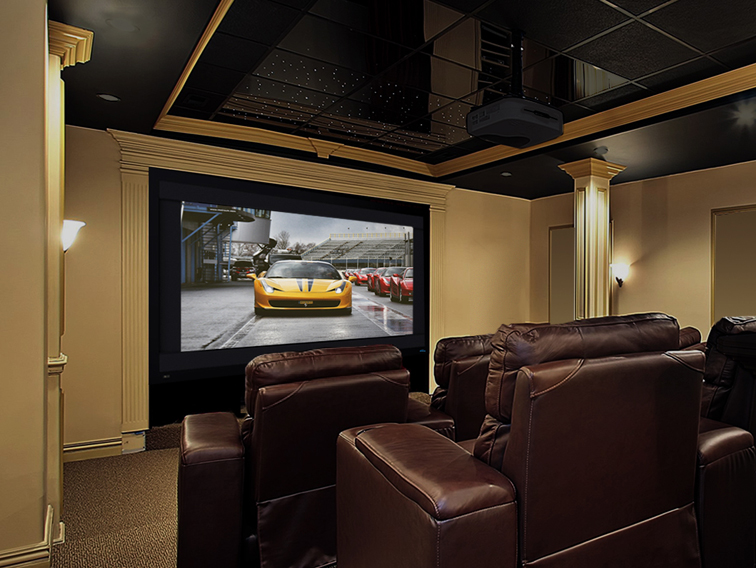
Choosing a screen, in detail
The screen is half of the picture and gets a fraction of the attention. It is the surface every photon lands on, and its gain, texture and colour neutrality shape the image as much as the projector does. Specify the two together — a screen chosen without reference to the projector's output and the room's light control is the most common reason a well-chosen projector underperforms.
Gain is a trade, not an upgrade. A higher-gain surface returns more light toward the centre seats and less to the sides, which narrows the useful viewing cone and can make brightness fall off across a wide row. In a properly dark room a neutral, lower-gain surface usually gives the better picture, with more even light and a cleaner black.
Then decide about acoustic transparency and masking. A perforated screen lets the left, centre and right sit behind it at ear height, which is how dialogue ends up coming from the actor rather than from above. Masking systems keep a black border against every aspect ratio, which matters more than it sounds — perceived contrast improves when the image is framed by black rather than by bare screen.
Hear these in Scottsdale and Tempe
Stewart screens are made to order, so the specification conversation happens before anything is built. Bring seating distances, row width and the projector you are considering, and we will work out size, gain and whether the front speakers belong behind the screen. Getting that sequence right saves rebuilding a wall later.