McIntosh MC275 Vacuum Tube Amplifier
Available to Order · Hear It in Tempe
$7,500
Contact UsThe McIntosh tube amplifier: introduced 1961, revived 1993, now in its sixth generation — 75 W per channel from four KT88s through the Unity Coupled Circuit output transformer.
Product Details
Description
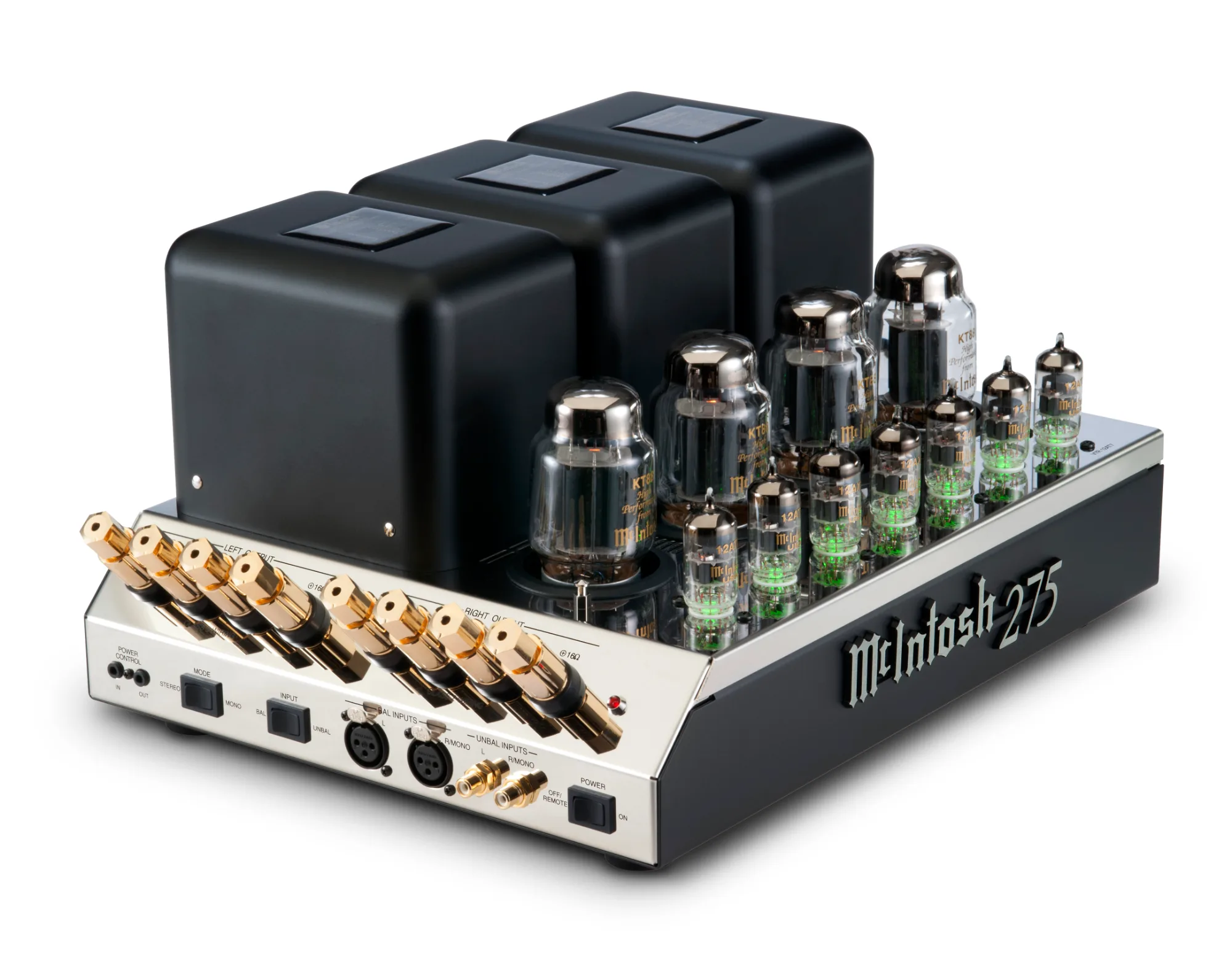
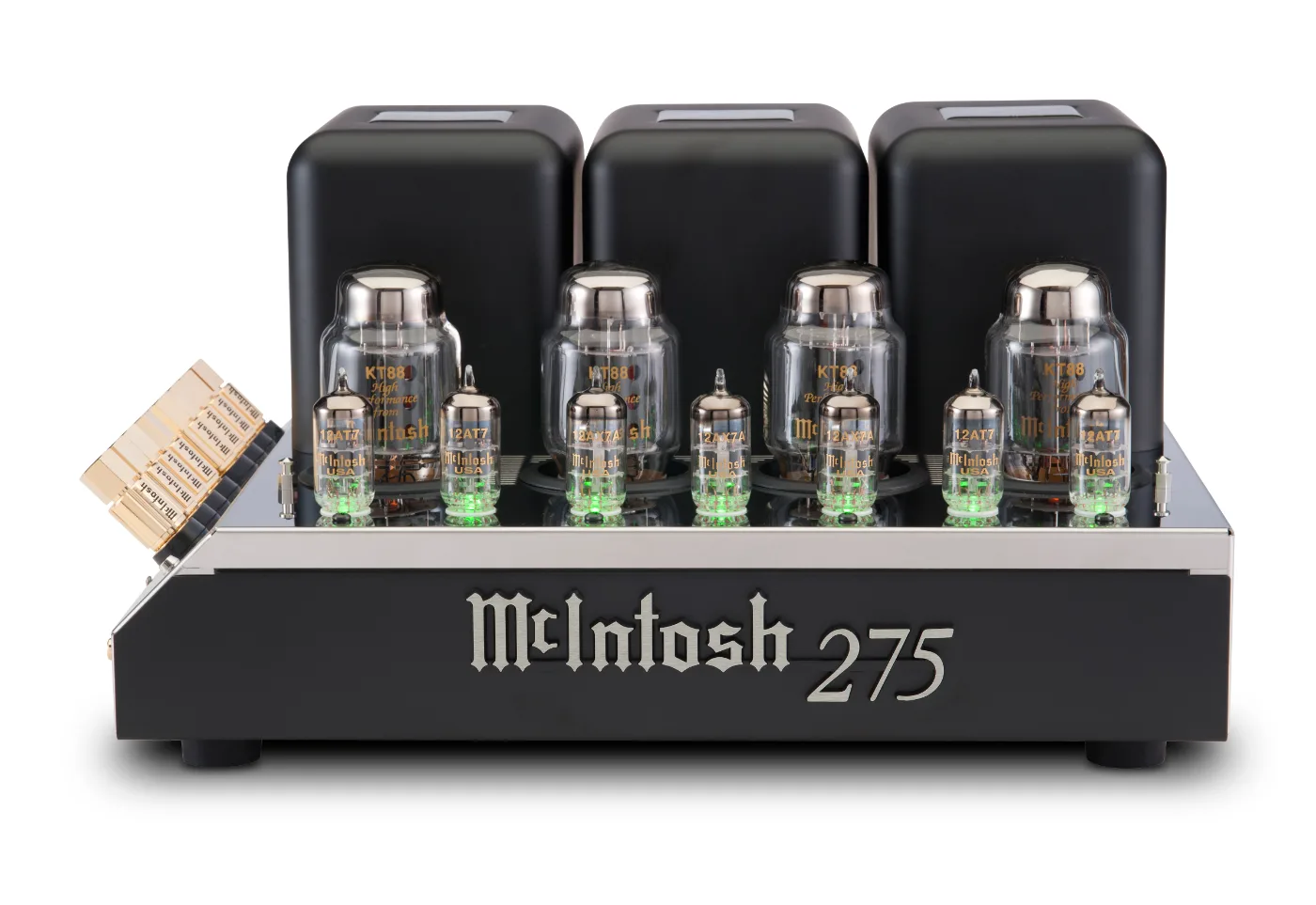
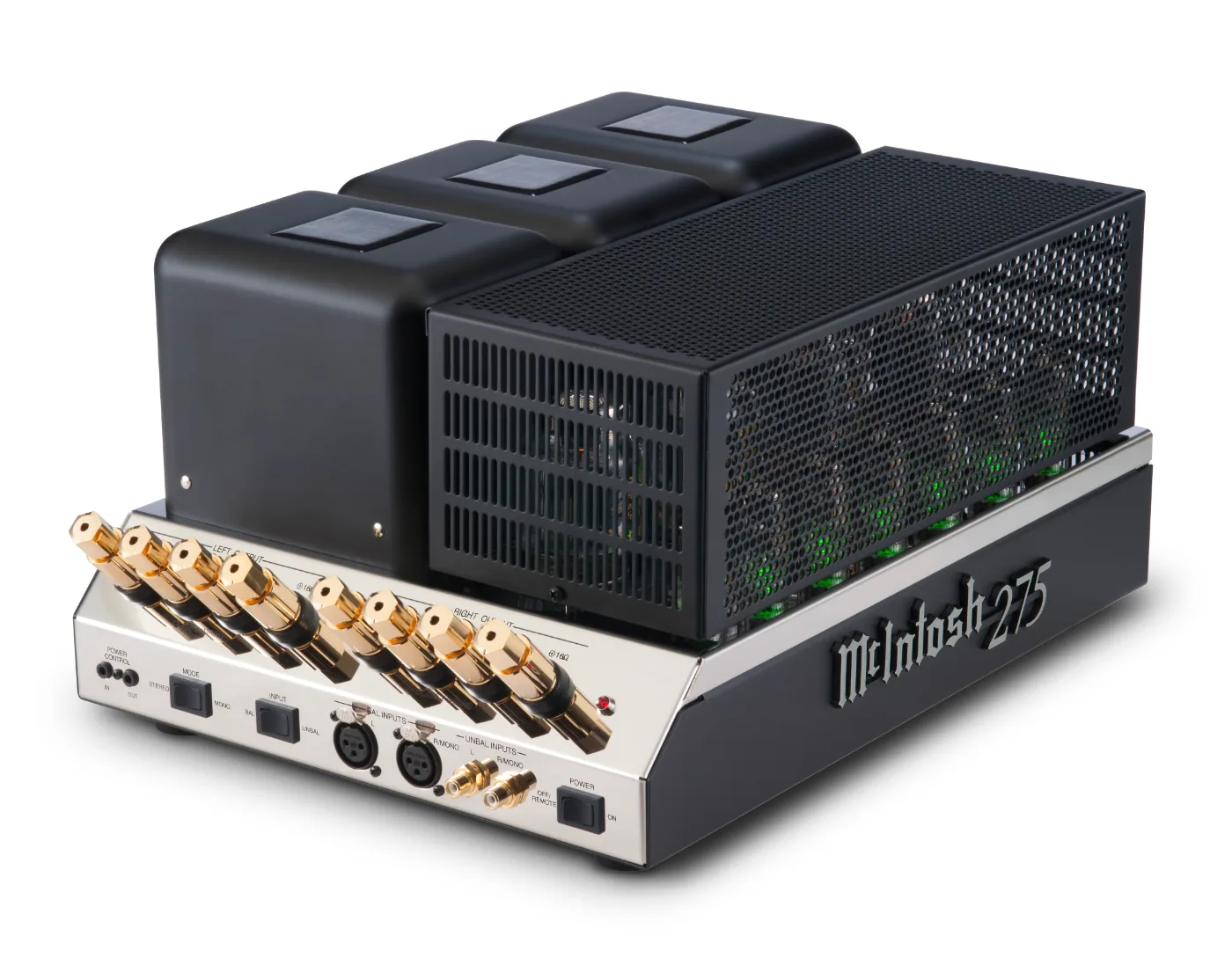
The McIntosh MC275 is the amplifier McIntosh is known for. Introduced in 1961, taken out of production in 1971 when the industry decided transistors had made tubes obsolete, and brought back in 1993 as a tribute to the company's late president, it has been in the McIntosh catalogue ever since. The amplifier on LMC's floor today is the sixth generation: 75 watts per channel from four KT88 output tubes through McIntosh's Unity Coupled Circuit output transformers, on a polished stainless steel chassis that a casual glance would not separate from the 1961 original. What has changed underneath is the subject of this page.
The Unity Coupled Circuit
Every MC275 ever built shares one piece of engineering: the Unity Coupled Circuit, the output topology Frank McIntosh and Gordon Gow patented in the late 1940s and founded the company on in 1949. The output transformer is bifilar-wound, meaning both primary windings are laid down side by side so that each turn of one sits against the matching turn of the other. The coupling between them is close to total, which removes the notch distortion that conventional push-pull tube stages produce at the instant one tube hands the signal to the other. Half of each output tube's load sits in the cathode circuit and half in the plate, which places the output tubes inside a local feedback loop, lowers their distortion and internal resistance, and is the reason an MC275 has never needed bias or balance adjustment to meet its published figures.
The practical result for a buyer is the one McIntosh has advertised since 1961: full rated power into 4, 8 or 16 ohm loudspeakers, not a figure that collapses as the impedance drops. McIntosh still winds these transformers in Binghamton, New York.
1961: the original
The MC275 was designed by Sidney Corderman and the McIntosh engineering team and introduced in 1961 at a list price of $444, alongside its mono sibling, the 75-watt MC75. It was the most powerful stereo amplifier McIntosh had built: two 75-watt channels in one chromed steel chassis, point-to-point wired, running a 450-volt supply, with a published frequency range of 16 Hz to 40 kHz within 0.1 dB.
It was also the most configurable version McIntosh ever made. A three-position switch turned it into a stereo amplifier, a pair of independent 75-watt amplifiers for use with an active crossover, or a single 150-watt mono amplifier. It carried a balance control, individual gain controls, and an octal line-output socket offering 70.7-volt, 115-volt, 230-volt and 600-ohm constant-voltage taps for commercial distributed-audio work. A 117/125-volt line switch on the panel is a reminder that domestic mains regulation could not be relied upon in 1961.
McIntosh gives 1971 as the year the original left production; some references extend it to 1973. Either way, the reason was the same: the market had decided solid state was the future, and McIntosh followed it. Original chrome-chassis examples are now among the most sought-after vintage amplifiers in the hobby, which is where the second half of the story begins.
1993: the Gordon Gow Commemorative Edition
Gordon Gow joined Frank McIntosh as vice president at the company's founding in 1949, co-invented the Unity Coupled Circuit, became president in 1977 and led the company until his death in 1989. In 1993 McIntosh brought the MC275 back in his name. Sidney Corderman came out of retirement to work on it.
McIntosh describes the Commemorative Edition as a faithful reproduction, and visually it is: chromed chassis, original panel layout, a commemorative badge on the side. The changes were deliberate. Gold-plated balanced XLR inputs appeared for the first time alongside the unbalanced pair. Construction moved to a hybrid of fiberglass circuit boards and point-to-point wiring, with close-tolerance film resistors and polypropylene capacitors. A silicon rectifier supply replaced the tube rectifier, and thermistors were added to limit inrush current at switch-on, which extends tube life. Noise improved from 90 dB below rated output to 100 dB.
The Commemorative Edition was meant to be a limited run. It sold far beyond anyone's expectation, and McIntosh, cautiously at first, went back into the vacuum tube business. Every McIntosh tube product made since, including the C22 preamplifier that LMC pairs with the MC275 in Tempe, traces to that decision.
Every version since
Version 3 (1995–2003)
The Commemorative Edition circuit without the badge, and one significant change: polished stainless steel replaced chrome plating. Chrome on the 1961 and 1993 amplifiers is prone to pitting and lifting with age; stainless is not. A titanium-gold finished variant, the MC275G, was built in small numbers in the late 1990s and is the rarest of the modern amplifiers.
Version 4 (2004–2007)
The first fully printed-circuit MC275. A power switch was added, the front-mounted convenience outlet was removed, and the mains inlet moved to a socket on the rear. The small-signal tube complement settled into the arrangement still used today, three 12AX7A and four 12AT7, and damping factor rose from greater than 10 to greater than 14, which shows up as firmer control of the woofer. Gain controls were retained.
Version 5 (2007–2012)
Rebuilt for RoHS lead-free compliance. The gain controls were removed, simplifying the signal path, and the barrier-strip speaker terminals gave way to five-way binding posts. Early production used small plastic-bodied posts; later units moved to gold-plated metal.
50th Anniversary and Version 6 (2012–present)
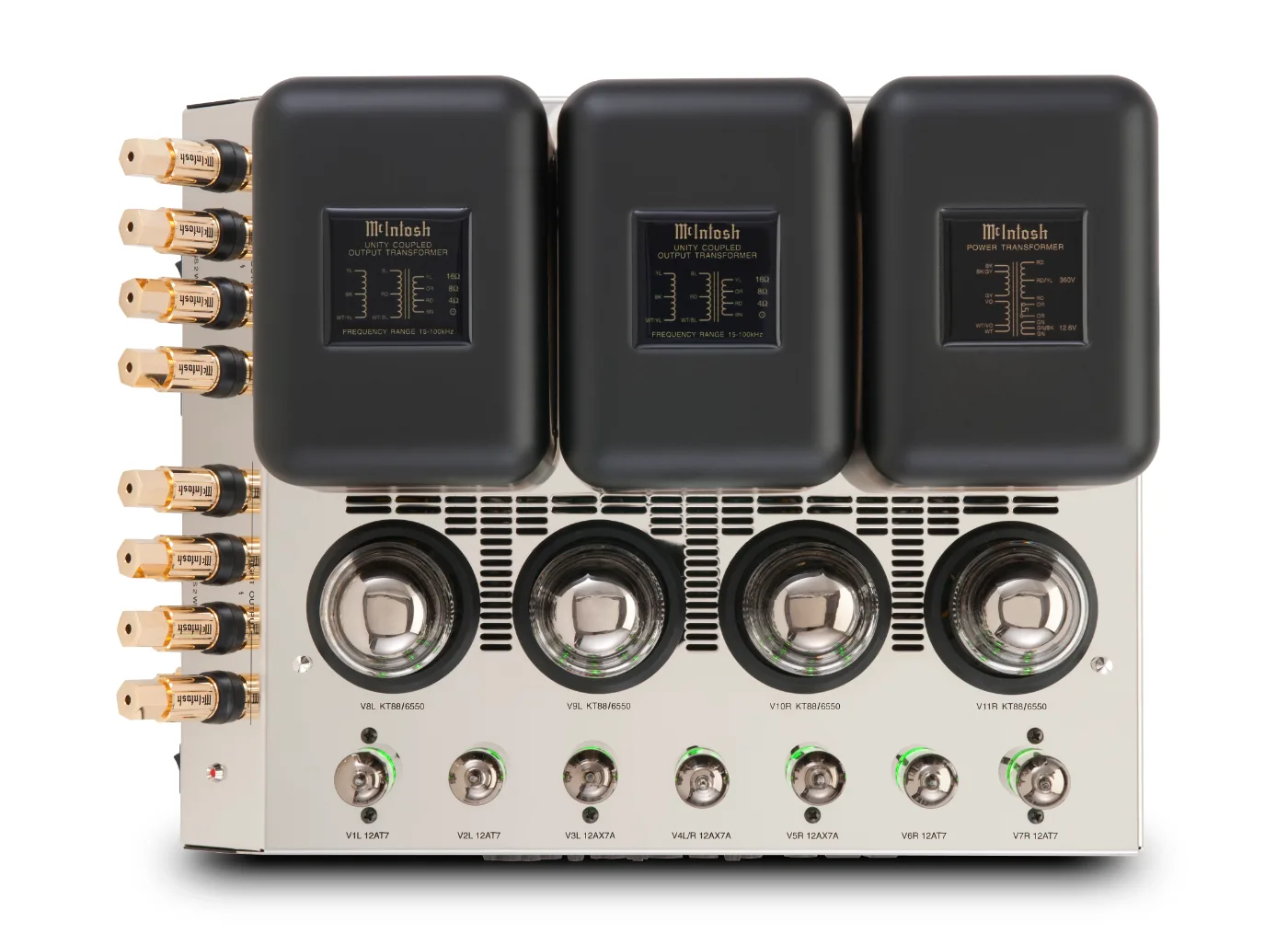
In 2012 McIntosh marked the amplifier's fiftieth year with a limited edition of 275 units in a gold-finished stainless chassis, and the design work for that edition became the sixth-generation MC275 that remains in production. It is the most substantial revision since 1993. The high-voltage supply rises from 450 to 490 volts. The output transformers are new. Feedback is taken from the loudspeaker side of the output transformer rather than the amplifier side, which puts the transformer inside the feedback loop and is measurable: damping factor climbs to greater than 22, and noise falls to 105 dB below rated output. The seven small-signal tubes sit on LED-illuminated bases that glow amber in sequence at switch-on and turn green when the amplifier is ready; if an output tube fails, the small tube in front of it turns red, so the owner knows which one to replace without a meter. Sentry Monitor provides fuse-less short-circuit protection that disengages the output stage and resets itself once conditions return to normal. McIntosh's Solid Cinch binding posts replace the earlier five-way type, and Power Control in and out lets the amplifier switch on and off with the rest of a McIntosh system.
What has never changed
Across every generation: 75 watts per channel into 4, 8 or 16 ohms in stereo, 150 watts into 2, 4 or 8 ohms in mono; four KT88 output tubes and seven small-signal tubes; maximum 0.5 percent harmonic distortion at any level from 250 milliwatts to rated power, 20 Hz to 20 kHz; and the Unity Coupled Circuit output transformer, wound in-house.
Identifying a used MC275
Because the chassis has changed so little, the panel details are how the generations are told apart. Chrome chassis with an octal socket on the angled panel, a balance control and a stereo/twin/mono switch is a 1961 original. Chrome with a commemorative badge on the side is the 1993 edition; the same amplifier in stainless steel without the badge is Version 3. Stainless with gain controls, a rear mains inlet and barrier-strip outputs is Version 4. No gain controls and five-way binding posts is Version 5. Recessed output tubes, illuminated small-tube bases and large binding posts on the angled panel is the current sixth generation. On any used example, ask when the tubes were last replaced: a matched quad of KT88s plus seven small-signal tubes is a meaningful fraction of the amplifier's value.
The MC275 at LMC
At LMC the MC275 sits in the Tempe Hall installation, paired with the C22 vacuum tube preamplifier and ML1 Mk II loudspeakers as a complete McIntosh tube signal chain in the format the company was built around. At 75 watts it is not an amplifier for insensitive, low-impedance loudspeakers; it is at its best with efficient designs and moderate rooms, which is exactly how the Tempe system is configured. Walk in during business hours or book ahead if you would like the system warmed up against your own recordings.
Featured Specs
Power Output
75 W per channel into 4, 8 or 16 ohms (stereo); 150 W into 2, 4 or 8 ohms (mono)
Tubes
4 x KT88 output; 4 x 12AT7 and 3 x 12AX7A input, voltage and driver stages
Output Stage
Unity Coupled Circuit output transformers, wound in-house at McIntosh
Distortion
0.5% maximum from 250 mW to rated power, 20 Hz to 20 kHz (≤ 0.25% at 1 kHz)
Generation
Sixth-generation MC275 (2012 design) — 490 V supply, feedback from the loudspeaker side of the output transformer, damping factor greater than 22
General Specs
Power Output
75 W per channel into 4, 8 or 16 ohms; 150 W mono into 2, 4 or 8 ohms
Circuit
Push-pull vacuum tube, Unity Coupled Circuit output transformers
Tube Complement
4 x KT88; 4 x 12AT7; 3 x 12AX7A
Total Harmonic Distortion
0.5% maximum at any power level from 250 mW to rated output, 20 Hz to 20 kHz
Signal-to-Noise
105 dB below rated output
Frequency Response
+0, −0.5 dB from 20 Hz to 20 kHz; +0, −3 dB from 10 Hz to 100 kHz
Damping Factor
Greater than 22
Dynamic Headroom
1.2 dB
Inputs
Balanced (XLR) and unbalanced (RCA)
Protection
Sentry Monitor fuse-less short-circuit protection; LED-illuminated small-signal tubes indicate status and identify a failed output tube
Speaker Terminals
McIntosh Solid Cinch gold-plated binding posts
System Control
Power Control input and output
Chassis
Polished stainless steel; black glass front panel
Dimensions
16½ in W x 8½ in H x 12 in D (41.9 x 21.6 x 30.5 cm)
Weight
67 lb (30.5 kg)
Warranty
3-year McIntosh limited warranty
Price
$7,500 (current McIntosh pricing)
Finishes
More from this brand
Come Hear It
Visit the Showroom
See and hear this in one of our reference rooms. Walk in or book ahead, in Scottsdale or Tempe.