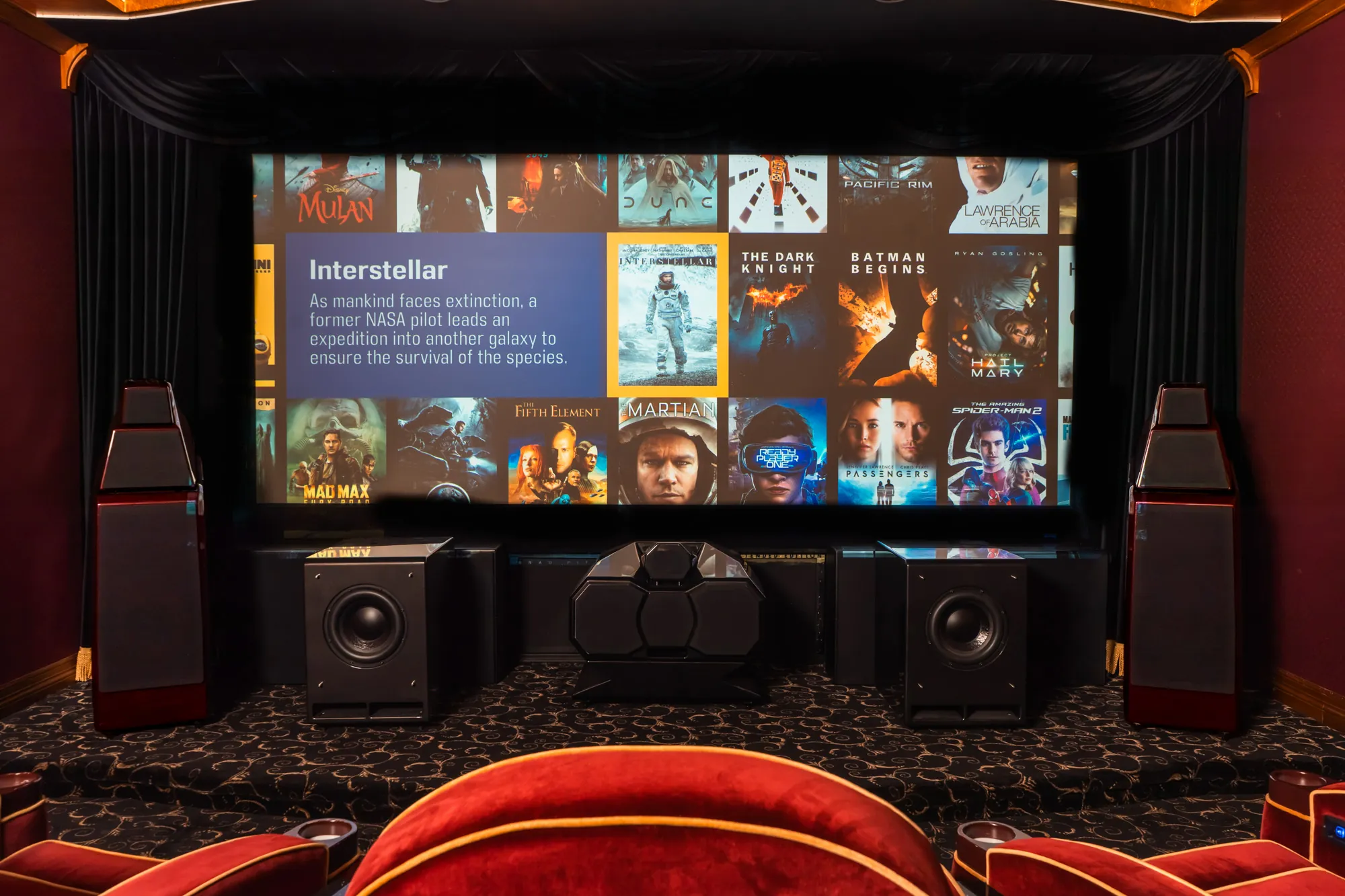
Luxury Cinema · Calibration & Support
Home theater maintenance and calibration in Scottsdale — a permanent partnership
Trinnov commissioning, multi-year recalibration, and the twenty-year client relationship that supports rooms across their life.
A reference cinema is not a project that concludes at commissioning. It is a room that requires calibration, recalibration, firmware updates, equipment refreshes, and — over the years — sometimes complete topology upgrades.
Rooms LMC built a decade ago are still being recalibrated by the same team that built them, and that longevity is not incidental to what a reference cinema is. It is one of the things a reference cinema is.
Most dealers treat calibration as a commissioning event and support as a service call. We treat both as extensions of the design relationship — the same team, the same specifications, the same equipment familiarity, applied across the years the room is in use rather than concluded at handoff.
The commissioning phase — what happens after the install is done
A home theater built to cinema standard does not stay at that standard on its own. Commissioning sets the reference; the recalibration schedule is what holds it there as equipment, content formats and the room itself change.
Commissioning is the first calibration event, and it is the most consequential one. It happens after the install phase closes — after acoustic treatment is installed, after the equipment rack is populated and terminated, after every speaker and subwoofer is located to its design coordinates, after the projector is aligned and the screen is tensioned. What commissioning does is measure the room's actual acoustic and video behavior against the design targets, and set the system's processing and configuration to bring the room to those targets.
For audio, that means Trinnov Altitude calibration — a measurement discipline that captures the room's frequency response, time-domain behavior, and spatial characteristics at multiple points across the seating plane, and uses that measurement to correct the acoustic realities of the room after the acoustic treatment has done everything it can. Trinnov's proprietary optimizer is one of the reasons we default to the Altitude platform on reference cinema rooms — the measurement resolution, the correction algorithms, and the upgradability of the platform across content standards are ahead of the alternatives at this tier.
For video, commissioning includes projector geometry alignment, focus uniformity verification, color calibration to the appropriate reference standard (typically Rec.709 for HD sources and BT.2020 or DCI-P3 for 4K HDR content), and gamma calibration to the display curve the room's ambient light behavior supports. We use ISF-level calibration tooling and the manufacturer's alignment procedures on every commissioning event, and the calibration data becomes the reference against which future recalibrations are measured.
For control system integration, commissioning includes scene programming for each content type the client identified in the consultation phase, lighting cue coordination, HVAC coordination for extended sessions, and remote monitoring configuration for support access. The client walks through the room's operation with the LMC team during commissioning, and any adjustments to scene behavior or user interface preferences are made before the handoff meeting.
The handoff meeting and the twenty-year relationship
The commissioning phase closes with a handoff meeting between the LMC team and the client. We walk the room together, review every operational scenario the room supports, hand over documentation — the as-built package from install, the calibration report from commissioning, the source library index if a Kaleidescape system is in place, the control system operating guide — and set the schedule for the ongoing relationship.
That schedule is not a service contract. It is an expectation, negotiated with the client, of when we will return. Typically we recommend a recalibration event at six months after commissioning — the room's acoustic behavior settles as materials cure, the client's use patterns become clear, and small corrections that would drift into larger issues get addressed while they are still small. After the six-month event, we recommend annual recalibrations as the baseline, with additional events triggered by content standard changes, equipment updates, or changes in the room's contents or use.
That schedule is what makes the twenty-year relationship real. Clients whose rooms LMC built years ago are clients we still see, still calibrate, still update firmware for, still spec upgrades against as their use patterns evolve and as new content standards emerge. The equipment specifications made during the design phase — Trinnov's upgradable processor path, McIntosh's rebuildable amplifiers, Wilson's serviceable driver architecture, Kaleidescape's forward-compatible library format — were made with that twenty-year horizon in mind.
Recalibration triggers — when a room needs attention
Rooms change across their life. Some of the change is invisible — component drift, driver settling, room material curing across the first year. Some of it is more visible — a new piece of furniture that shifts the room's absorption pattern, a projector lamp that has aged past its color-accurate window, a firmware update that changes how the processor handles a new content format. Recalibration events are triggered by both types.
Content standard changes
When Dolby Atmos overtook 7.1 as the reference content standard, rooms built for 7.1 topology needed height-channel additions to reach the new standard. When Dolby Vision and HDR10+ overtook standard HDR as the reference video standards, projectors and processors needed firmware updates and — in some cases — replacement to keep pace. When new immersive audio formats emerge, rooms whose processors are upgradable can be brought forward; rooms whose processors are not have to be replaced. Our design-phase preference for the upgradable Trinnov Altitude platform is one of the reasons the rooms we build stay reference-current for longer than most.
Equipment updates
Projector lamps age; laser light engines drift over thousands of hours of use; amplifiers evolve through manufacturer revisions; processors receive firmware updates that change how they handle content. Each of these is a trigger for a recalibration event that re-measures the room against its commissioning reference and corrects whatever the change has moved.
Room content changes
A new sofa, a change in flooring, a rug added or removed, a piece of art hung on a wall that was previously bare — every one of these changes the room's acoustic behavior enough that a recalibration is warranted. Some clients are attentive to this and call us proactively; others are less aware, and the annual recalibration schedule catches the accumulated small changes.
Ambient behavior changes
The room's ambient light changes across seasons in a house with significant natural light adjacencies; the room's HVAC behavior changes as the building's HVAC system ages; the room's electrical behavior changes as other loads in the house evolve. Each of these can affect the cinema's performance and each can be addressed during a scheduled recalibration.
Kaleidescape, library management, and source system support
Kaleidescape is the source system standard on nearly every LMC-built cinema, and it is one of the source systems where ongoing support matters most. Library management — cataloging, metadata updates, playlist curation, download queue management, guest-user configuration — is an ongoing task that the client either takes on themselves or delegates to us as part of the support relationship.
We handle library management for clients who prefer to have the source system maintained rather than managing it themselves. New titles get added on release, metadata gets verified, cover art is retrieved for older releases where Kaleidescape's catalog has evolved, and playlists get curated against the client's content preferences. Clients whose primary use is spontaneous rather than planned viewing benefit from a maintained library — the room supports the sit-down-want-to-watch-something scenario rather than requiring the client to spend fifteen minutes browsing before content starts.
Streaming source support runs on a parallel track. Apple TV 4K, NVIDIA Shield, or dedicated streaming appliances integrated with the control system — configuration, firmware updates, and app management for the streaming layer are part of the ongoing relationship for clients who use it.
Physical media playback, where the client's library extends to 4K Blu-ray or SACD, is supported with rack-mounted players integrated into the control system and calibrated to match the room's reference behavior on other sources.
The showroom rooms — reference cases for how support works
The three reference cinemas on demonstration at LMC are the clearest illustration of what the ongoing calibration and support relationship looks like in practice. Each of these rooms is calibrated on a schedule that matches or exceeds what we recommend to clients, because the showroom rooms serve as the reference against which client rooms are compared and against which our own team's calibration discipline stays sharp.
The Cinema Suite in Scottsdale is recalibrated on a regular cycle — the Wisdom Audio planar mains behind the Stewart Filmscreen require periodic verification of the front-channel geometry and the Trinnov Altitude16 room correction, particularly after any changes to seating position or content standard.
The Grand Cinema Suite in Scottsdale runs the more complex topology — 32 channels of Trinnov Altitude32 processing across McIntosh XRT2.1K line arrays, Sonus faber Arena in-walls, and REL Carbon Special Black Label subwoofer arrays — and requires a longer commissioning cycle to maintain the alignment and time-domain integrity across that channel count. When Barco releases firmware updates for the Freya projector or Trinnov releases optimizer updates for the Altitude32, the Grand Cinema Suite is where our team validates the update before rolling it out to client rooms.
The Tempe Theater — with its Wilson Audio Alexia V and Mezzo CSC front three, Wisdom in-walls, six Ascendo 2-19 subwoofers, Sony VPL-VW995ES projection, and Trinnov Altitude32 processing — carries its own recalibration cycle and serves as the reference for hybrid music-and-cinema rooms.
The discipline that keeps these three rooms at reference is the same discipline we apply to client rooms. The support relationship is not a lesser tier of what happens at the showroom; it is the same team, the same equipment, the same procedures, applied on the schedule the client's room requires.
Emergency service and remote support
Not every support event is a scheduled recalibration. Equipment fails, firmware updates cause unexpected behavior, network configurations drift, and clients occasionally need a room to be operational for an event on short notice. Our support team handles emergency service calls with a response cadence that matches the client's need.
Remote monitoring and remote support — where the client's control system, network, and key components are configured for authorized remote access — resolves a meaningful fraction of support events without requiring an on-site visit. Firmware updates, configuration changes, network diagnostics, and control system reprogramming can be handled remotely when the room's infrastructure is configured to support it.
On-site emergency service is available when remote resolution is not possible. Our team can typically be on site within one to two business days for support events that require physical presence, with faster response available for critical events. Support agreements can be structured around specific response-time commitments for clients whose use of the room is business-critical or event-driven.
What ongoing means in practice
Ongoing means what the word implies. It means the team who built your room is the team you call when something needs attention. It means the calibration data from your commissioning is the reference against which every subsequent recalibration is measured, so drift is caught early rather than after it has become audible or visible. It means the equipment we specified was chosen with an upgrade path in mind, so a firmware update or a component replacement extends your room's useful life rather than triggering a replacement cycle. It means we are still calibrating rooms we built a decade ago because those rooms are still reference cinemas, and staying reference is what the ongoing relationship is for.
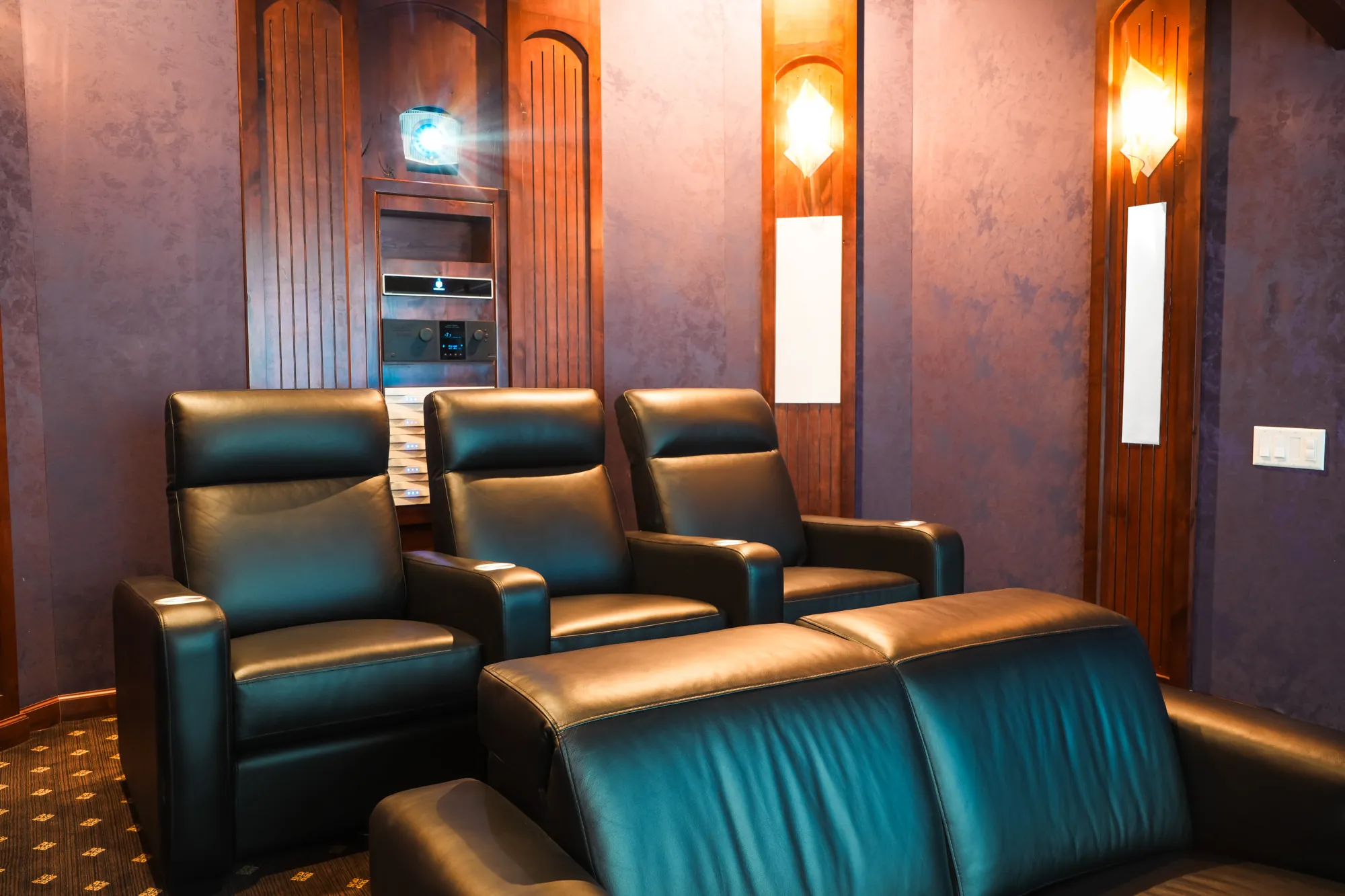
The three cinemas that we still calibrate
Every reference cinema on demonstration at LMC is calibrated by the same team that will calibrate yours. Walk in during business hours or book ahead to hear what a properly commissioned and recently recalibrated cinema sounds and looks like.
Cinema Suite (Scottsdale) · Wisdom Audio planar mains behind Stewart Filmscreen · Trinnov Altitude16 (20 ch) · Sony projection · Kaleidescape
Grand Cinema Suite (Scottsdale) · McIntosh XRT2.1K line arrays · Sonus faber Arena in-walls · REL Carbon Special Black Label sub arrays · Trinnov Altitude32 · Barco Freya · Alchemy ICMP-X · Kaleidescape
Tempe Theater (Tempe) · Wilson Audio Alexia V + Mezzo CSC · Wisdom in-walls · 6× Ascendo 2-19 subs · Trinnov Altitude32 · Sony VPL-VW995ES · Kaleidescape
Frequently asked
How often should a reference cinema be recalibrated?
We recommend a recalibration event at six months after commissioning, then annually as the baseline. Additional events are triggered by content standard changes, equipment updates, or changes in the room's contents or use.
Do you support rooms built by other dealers?
On a case-by-case basis. Rooms built to a standard our team can work with — proper acoustic construction, serviceable equipment, calibratable processing — can often be brought onto our support relationship. Rooms built below that standard sometimes cannot be economically supported at reference level, and we say so honestly in the initial evaluation.
Can Trinnov calibration compensate for a poorly designed room?
Partially. Trinnov's optimizer is genuinely capable, but it corrects electrical signals — it cannot move a speaker, add an absorber, or change a ceiling height. The rooms Trinnov performs best in are rooms whose acoustics were designed correctly and whose calibration Trinnov refines rather than rescues.
What happens when a content standard changes — do I need a new processor?
Depends on your processor. Trinnov Altitude platforms are designed to be upgradable across content standards; new formats typically arrive as firmware updates rather than hardware replacements. Non-upgradable processors more often require replacement when standards evolve, which is one of the reasons we default to the Altitude platform on rooms of this tier.
How do you handle firmware updates?
Firmware updates on major components — projectors, processors, source systems — are validated on our showroom rooms before we roll them out to client rooms. Updates that produce regressions in a showroom room don't reach client rooms until the regression is resolved.
Is there a service agreement, or is support billed per event?
Both are available. Some clients prefer a scheduled service agreement with defined response commitments; others prefer to pay per event as needs arise. We work with the client to structure the support relationship that matches their use of the room.
The full LMC cinema methodology
Calibration and support is one phase of the four-phase LMC cinema methodology. Read how the other phases run.
Consultation — how a reference cinema begins →Design — how LMC designs a reference cinema →Installation — how a reference cinema gets built →Luxury Cinema at LMC — hub overview →