Brand
Kaleidescape
Reference-quality film, downloaded not streamed. Bitrates that beat Blu-ray, audio that stays lossless.

Authorized Dealer — Scottsdale & Tempe, Arizona
Trade-in credit toward new purchases · Full installation and calibration · Walk in during business hours or book ahead
See what's on demonstration now ↓Kaleidescape was founded in 2001 in Sunnyvale, California by Michael Malcolm and Cheena Srinivasan, with research and development based in Waterloo, Ontario. From the beginning the company set out to deliver film at the same quality the studios were shipping to commercial theatres, but into the home — first from ripped optical media, and from 2012 onward as direct download from an online store licensed by every major studio. That original goal has held. Twenty-five years in, Kaleidescape is the only source in the private cinema world that delivers full-fidelity 4K with lossless multichannel audio, downloaded rather than streamed.
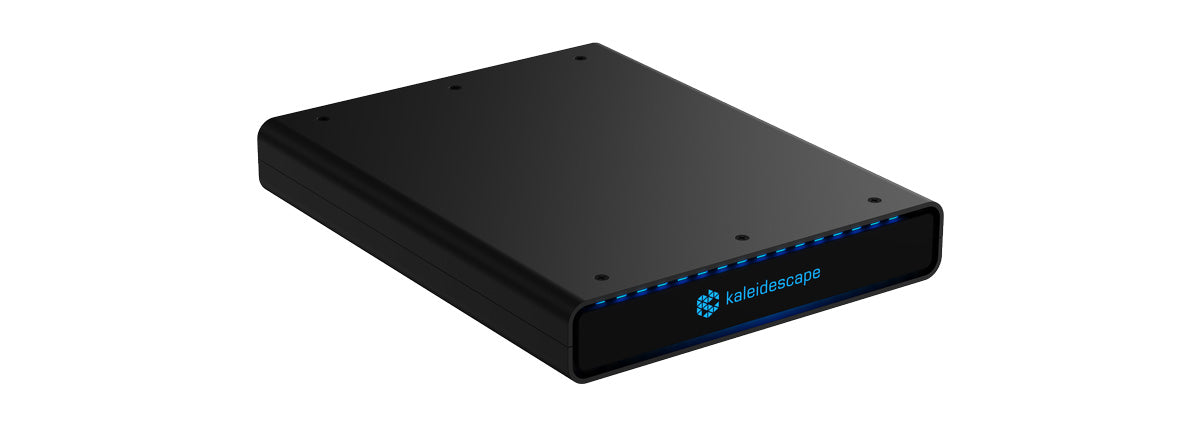
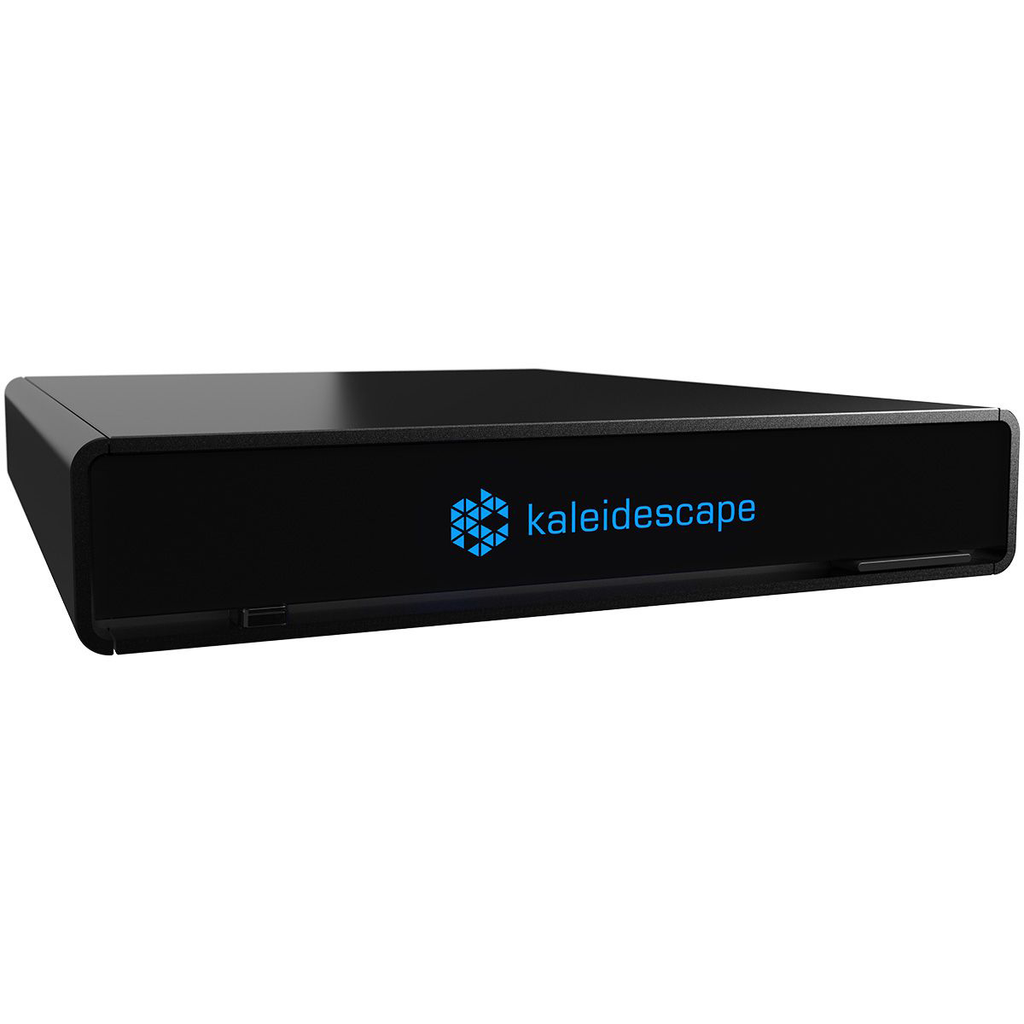
The current player range runs Strato M, Strato E, Strato V, and the recently launched flagship Strato K, which unlocks native 8K playback and introduces Kaleidescape’s exclusive new 4K Cinematic format. Terra and Terra Prime servers hold the library and scale to substantial installations. Every Strato player can operate standalone with its own internal drive, or group with one or more Terra servers to become one room in a whole-house entertainment system. LMC specifies Kaleidescape for every dedicated cinema it builds, and it is on demonstration in both Scottsdale cinema theatres — the Grand Cinema Suite and The Cinema Suite — as well as in the Tempe Theater.
The download-not-stream premise
The trade every streaming service makes is bitrate for bandwidth. A film delivered by a streaming service typically arrives at six to eight megabits per second. A UHD Blu-ray disc runs to around fifty. Kaleidescape’s standard 4K files run well above that, and the flagship Strato K supports bitrates up to about a hundred and ten megabits per second on the new 4K Cinematic format — over five times what streaming delivers, more than twice what disc manages. The extra data is not a specification detail. It is the compression artifacts you don’t see, the shadow detail that survives dark scenes, the skin tones that don’t band, the smooth panning that doesn’t break into blocks.
The 4K Cinematic format Strato K introduced adds a second dimension to the improvement. Standard 4K on Blu-ray, streaming and prior Kaleidescape uses 4:2:0 chroma subsampling — the colour information is sampled at a quarter of the luma resolution. 4K Cinematic delivers full 4:4:4 chroma, one colour sample per pixel, with up to twelve bits of depth. It is the first consumer format to offer 4:4:4 chroma at 4K resolution, and it holds up on any 4K display — an 8K display is not required to benefit from the format.
Audio follows the same principle. Every Kaleidescape file is delivered with lossless multichannel and object-based audio intact. Dolby Atmos arrives as TrueHD rather than the compressed Digital Plus a streaming service sends. DTS:X arrives lossless. On a system with reference amplification and a properly corrected room, that difference is not subtle — it is the difference between hearing the mix and hearing a compressed approximation of the mix.
The Kaleidescape range at LMC
LMC carries the current Kaleidescape catalogue on the movie players and servers page. The Strato M is the entry point — a compact 4K player with the same store and interface as the flagship, sized for a media room or a bedroom system. Strato E adds larger internal storage. Strato V is the mid-tier player: substantially higher internal capacity, DCI compliance, the reference-tier build most dedicated cinemas specify when 4K Cinematic and native 8K are not primary requirements.
Strato K is the new flagship, and the first movie player certified by the 8K Association. It plays native 8K in HDR10 and SDR, plays the exclusive 4K Cinematic format at full 4:4:4 chroma, plays every prior Kaleidescape 4K title, and plays every Blu-ray and DVD-quality title in the library. HDMI 2.1 with HDCP 2.3 handles the video output. A dedicated one-terabyte solid-state drive stores roughly seven 4K Cinematic titles or about ten standard 4K titles standalone; combined with a Terra or Terra Prime server, the addressable library becomes the whole catalogue.
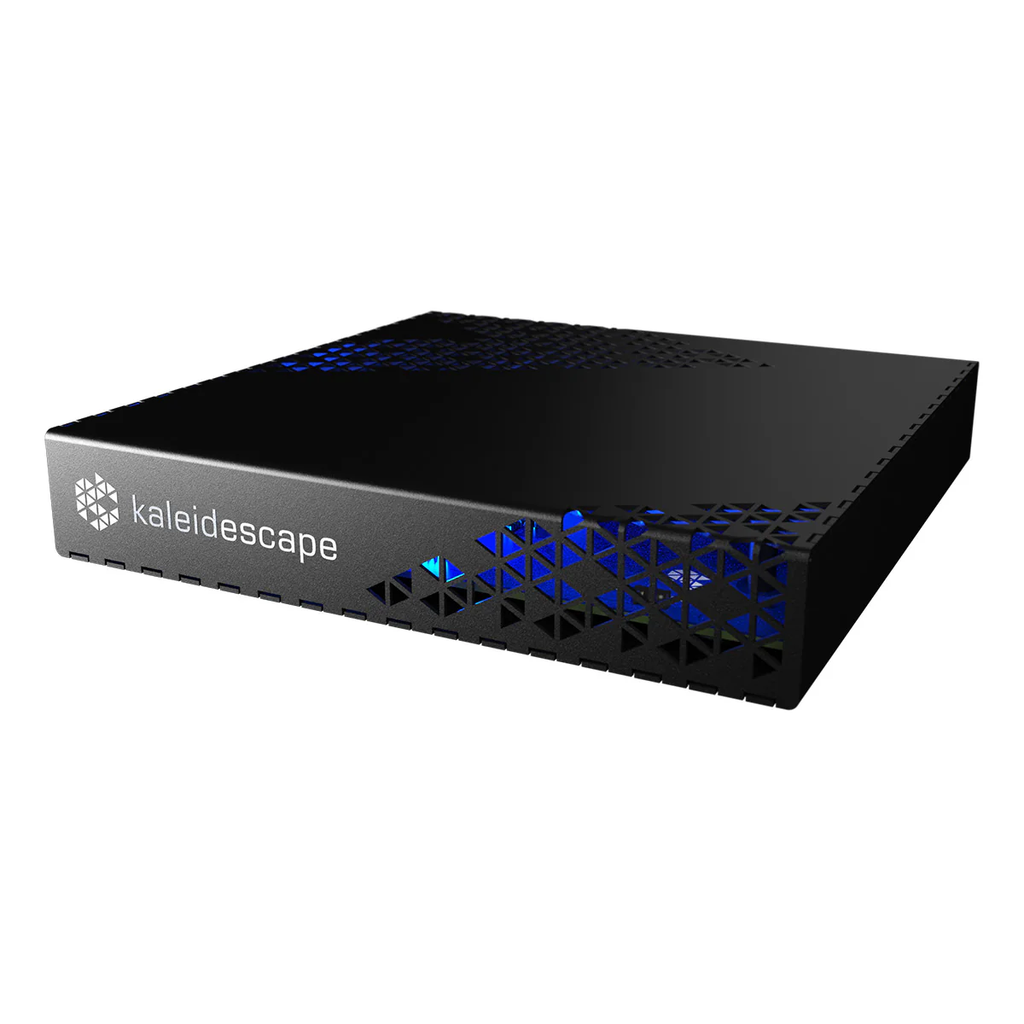
Terra and Terra Prime servers hold the film library. Terra scales storage across multiple units in the same system; Terra Prime is the newer, higher-capacity platform for larger installations. Both integrate with any combination of Strato players in a whole-house system, so the film downloaded once from the store plays back in any room from the same library.
Kaleidescape in the LMC cinema rooms
Kaleidescape is on demonstration in three rooms across the two showrooms. In Scottsdale, The Cinema Suite — a Wisdom Audio thin-film planar system behind an acoustically transparent Stewart Filmscreen, driven by Wisdom SA-3 amplification through a Trinnov Altitude16 processing up to twenty discrete channels, with Sony projection — runs from a Kaleidescape server as source. The Grand Cinema Suite pairs Kaleidescape source with the McIntosh XRT2.1K line array system on MC2.1KW and MC1.25KW monoblocks, Sonus faber Arena in-walls for surrounds and heights, REL Carbon Special subwoofer arrays, Trinnov Altitude32 correction, and Barco Freya native 4K DLP projection.
The Tempe Theater is the room that most clearly demonstrates why Kaleidescape source matters when everything downstream is doing its job. The front stage is Wilson Alexia V with the Mezzo CSC centre — loudspeakers chosen because they are among the best Wilson builds, not because they were designed for cinema — driven by McIntosh MC1.25KW monoblocks at 1,250 watts a side. Surrounds and heights run on Wisdom Audio thin-film planar in-walls and Focal in-walls. Six Ascendo 2-19 subwoofers handle the bottom, calibrated with the room by a Trinnov Altitude32. Source is a Kaleidescape movie player and server pair. The lossless TrueHD Atmos track surviving intact through this chain is the point of specifying Kaleidescape in the first place — everything Wilson, McIntosh, Wisdom, Focal, Ascendo and Trinnov are doing downstream is compromised the moment the source itself has been compressed.
LMC as a Kaleidescape dealer
LMC is a Kaleidescape dealer because a dedicated cinema built to the standard of the Grand Cinema Suite, The Cinema Suite and the Tempe Theater cannot resolve its bass calibration, its screen calibration, or its audio-object placement against a compressed streaming source. The dealer relationship is not a catalogue listing. It runs through installation partners qualified by Kaleidescape to specify Strato and Terra hardware into the network architecture of the room — a Kaleidescape system needs a wired gigabit Ethernet drop to every player, needs storage sized to the client’s viewing habits, and needs an integration with the room’s lighting, masking and processor control that a serious cinema treats as one design.
That specification work happens on site as part of the room design, not from a catalogue on the showroom floor. What the showroom does is demonstrate the difference — the same film on the same display, sourced from Kaleidescape and sourced from streaming, in a room built to reveal that difference. Once heard, the specification question answers itself.
Where to start
For a first Kaleidescape audition the Tempe Theater is the most useful room in the LMC portfolio, because everything downstream of the source is doing its job to reference standard — the compression the source is not doing becomes audible immediately. Bring a film scene you know well, ideally with dark shadows, deep bass, and a dialogue-heavy centre channel. Watch a segment sourced from Kaleidescape and then watch the same segment from a streaming service on the same system. The demonstration answers itself in about ninety seconds.
For an evaluation of the 4K Cinematic format specifically, the Grand Cinema Suite is the right room — the Barco Freya native 4K DLP is the display that most fully reveals what full 4:4:4 chroma at high bitrate delivers over standard 4:2:0. For a look at the whole-house architecture — one library on Terra servers, multiple rooms with their own Strato players, one interface across all of them — that conversation begins on site with the LMC integration partners.
What to watch and listen for
Two tests separate a Kaleidescape audition from an argument. First, watch a sustained dark scene — a night exterior, an underground scene, a shadowed interior. Streaming compression fails first in low-light detail, with banding across the sky and colour blocks in the shadows. A Kaleidescape file preserves the gradient because the bit budget hasn’t been spent on the wrong parts of the frame. Second, listen to a scene with quiet dialogue against a complex ambient bed — a conversation in a rainstorm, a whispered exchange with wind and traffic outside. Lossless multichannel Atmos keeps the dialogue clear because the ambient bed hasn’t been degraded to fit the bandwidth envelope. On a compressed source the same scene demands centre-channel volume adjustment to stay intelligible.
Walk in during business hours or book ahead if the audition needs the Tempe Theater or a specific Scottsdale cinema suite configured for extended demonstration.
The Lineup
Explore the Range
Experience The Brand