Brand
Analog Audio Design
New-production French reel-to-reel tape machines — Golden Ear 2024 from The Absolute Sound.
Authorized Dealer — Scottsdale & Tempe, Arizona
Trade-in credit toward new purchases · Full installation and calibration · Walk in during business hours or book ahead
See what's on demonstration now ↓Analog Audio Design is a French manufacturer of new-production reel-to-reel tape machines, based at Pleumeur-Bodou in Brittany and a member of the Trégor Sonore audio collective. The company was founded by Christophe Martinez, an engineer who spent twenty-five years developing flight-simulator electronics and software before joining Mulann RTM — the French group that holds much of the surviving European knowledge and process for manufacturing high-quality magnetic tape, and which owns the RecordingTheMasters brand.
That biography explains the product. The TP-1000 took four years to design and build, and it exists because someone with the electronics and firmware background to solve the control problem happened also to be working inside the company that still makes the tape. New-production reel-to-reel is a very short list; new-production reel-to-reel engineered from scratch rather than refurbished from old stock is shorter still.
The master-tape premise
Tape occupies a particular position in a reference system. A first-generation or second-generation copy of a master tape is the closest most listeners can come to the recording as the engineer heard it — ahead of vinyl, which adds a cutting and pressing stage, and ahead of digital, which adds conversion. The limitation has never been the format. It has been the machines, most of which were built decades ago and are maintained rather than manufactured.
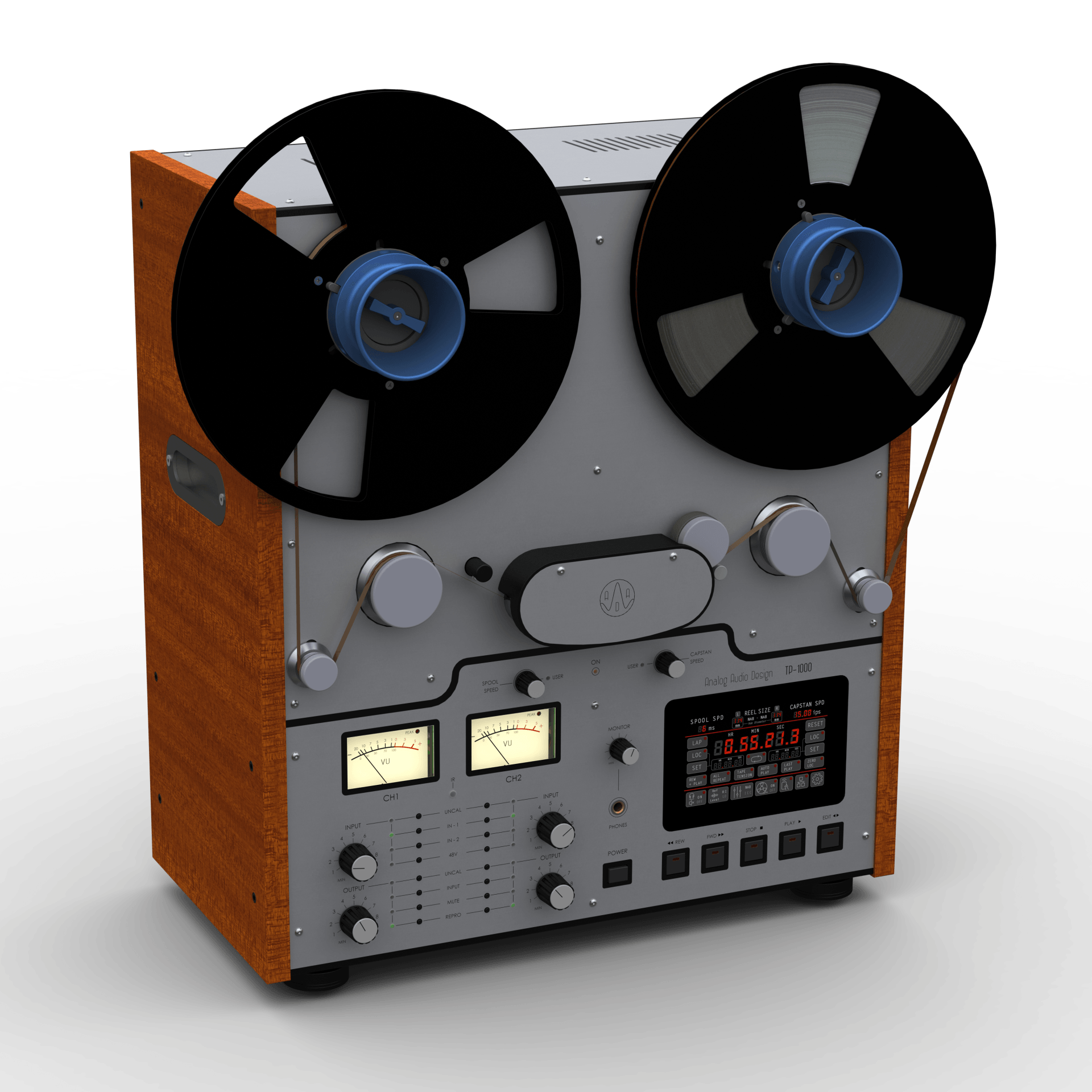
The TP-1000 addresses that directly. It is a quarter-inch, two-track player — playback only, by design — taking reels up to 30 cm, with switchable 15 ips and 7.5 ips speeds and switchable NAB or IEC equalisation curves. It is a three-motor machine using low-torque Swiss DC motors from Maxon on belt-driven reels and capstan, under microprocessor control. Wow and flutter measures below 0.045 per cent peak weighted at 15 ips.
The heads come from AM Belgium, who inherited the head specifications directly from Studer and ReVox when those operations closed — the playback head is the same one used in the Studer A800, A810, A812, A820 and A807. The cylindrical head shape presents a large contact area, which reduces both head wear and low-frequency head bump.
Around that mechanism sits a genuinely modern control layer: a touchscreen interface managing spool and capstan speed, tape tension, equalisation, playback fluxivity at 320 or 514 nWb/m for high-fluxivity tapes, three wind speeds, calibration and headphone level, with an RJ45 connector for firmware updates and control from a phone or tablet. It is a machine that behaves like current equipment while doing an entirely analogue job.
The Analog Audio Design line at LMC
The line comprises three current-production machines. The TP-1000 is the playback flagship. The TR-1000 adds record capability for those working with tape rather than only listening to it. The TP-1000 Gold Edition is the premium finish variant.
The TP-1000 was awarded a Golden Ear 2024 by The Absolute Sound following a review by Jonathan Valin, and — alongside the TR-1000 — has been recognised at the Capital Audio Festival and reviewed by Classica and others in the European audiophile press. The machines sit with LMC's analogue sources.
Analog Audio Design in the WAMM Room
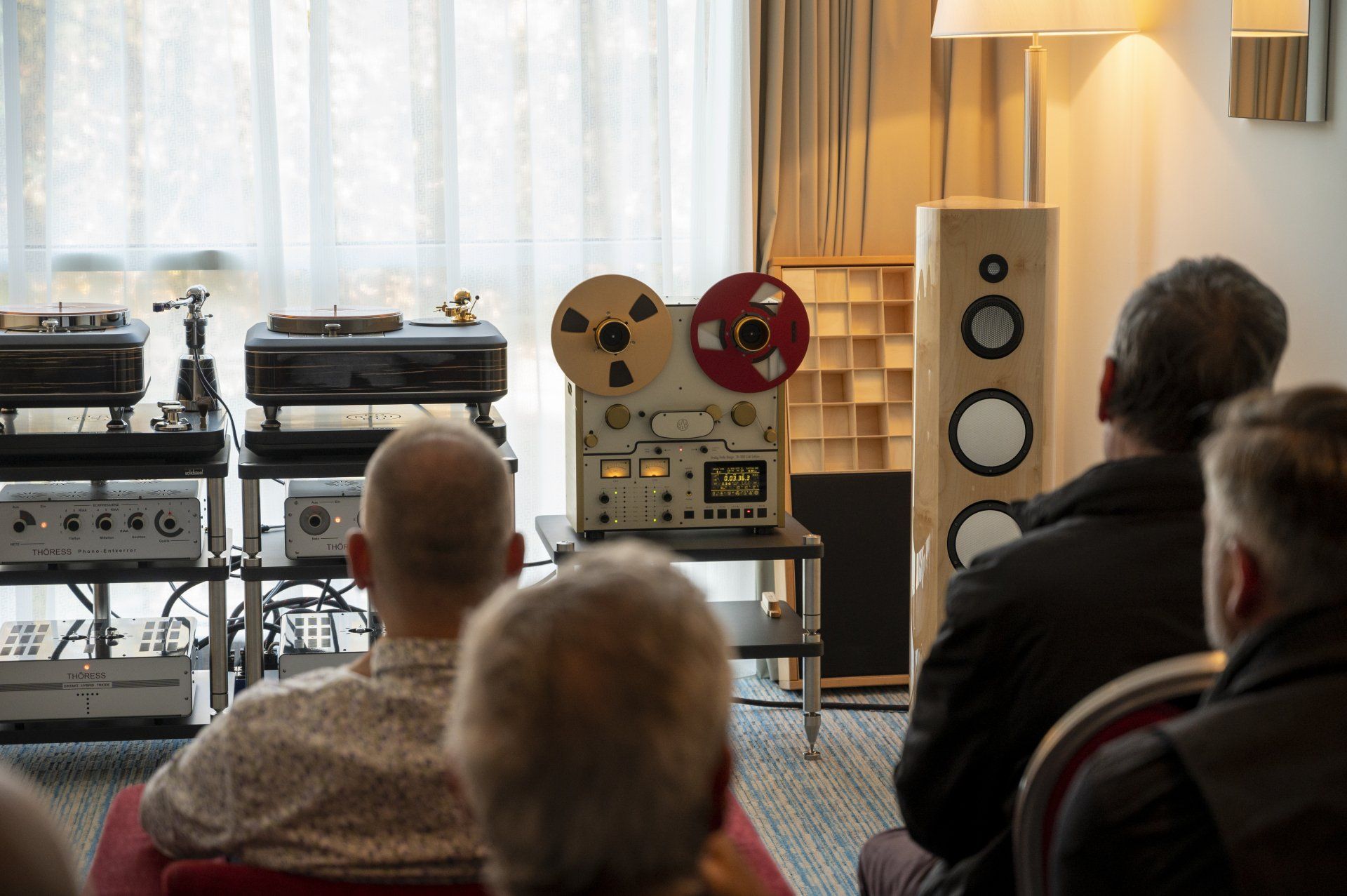
The reel-to-reel deck sits in the WAMM Room in Scottsdale, which is the correct room for it and not a coincidence.
That room is anchored by the Wilson Audio WAMM Master Chronosonic with a pair of WAMM Master Subsonic subwoofers, driven by D'Agostino Relentless 800 monoblocks with Momentum M400 MxV monoblocks on the subwoofers. Digital is the full dCS Varèse Music System — transport, DAC and Master Clock. Vinyl is the Clearaudio Statement V2 into a D'Agostino Momentum Phonostage. Transparent Ultra Gen 6 ties it together.
Putting a tape machine into that room makes a specific comparison available that almost nowhere else offers: the same reference system, three analogue and digital source paths at the highest tier each can reach, switchable in a single session. That is the only honest way to hear what tape actually contributes, because the variable being tested is genuinely the source and nothing else.
LMC as an Analog Audio Design dealer
Tape is not a plug-in format. Machines need alignment to the tapes being played, fluxivity has to be matched to the material, equalisation curve has to be correct for the tape's origin, and the phono-stage equivalent — the tape head preamplifier and its loading — has to suit the system it feeds.
LMC carries Analog Audio Design as the current-production analogue master-tape source for a reference-tier system that wants reel playback alongside vinyl, and treats it the same way it treats a turntable: set up against the software it will actually play, in the system it will actually live in.
Where to start
Start by being honest about the software. Tape is a format with a finite and expensive library, and the machine is only worth what you can feed it. If a collection of master-tape copies is already in hand or genuinely intended, the case makes itself; if not, the conversation is worth having before the machine rather than after.
If the system already has a reference turntable, the useful demonstration is a direct comparison rather than a tape demonstration in isolation. The WAMM Room makes that possible against the Clearaudio Statement V2.
If the interest is in recording as well as playback, the conversation is about the TR-1000 rather than the TP-1000, and that changes the specification meaningfully.
What to listen for
First, listen to the noise floor between tracks, and then to what sits just above it. Tape has its own noise signature, and the point is not that it is silent — it is that the low-level information sitting on top of that floor survives without the artefacts other formats introduce. Listen to reverb tails and room ambience rather than to the instruments.
Second, listen to dynamic transitions. Tape handles the approach to a loud passage differently from digital, without the hard ceiling that a converter imposes. A full orchestral crescendo or a drum strike should expand rather than compress as it reaches its peak.
Third, if a comparison is available, listen to the same recording on tape and on vinyl in sequence. The differences are real, consistent and not always in tape's favour on every recording, which is precisely why the comparison is worth doing in a room where both sources are at the same tier.
Walk in during business hours or book ahead if the audition needs the WAMM Room configured for tape playback against specific material, or against the vinyl front end for direct comparison.
The Lineup
Explore the Range


Experience The Brand