Brand
Martin Logan
Electrostatic loudspeakers — engineered for absolute transparency, handbuilt in Kansas since 1983.
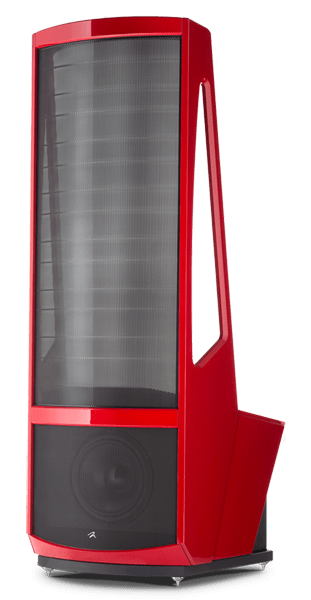
Authorized Dealer — Scottsdale & Tempe, Arizona
Trade-in credit toward new purchases · Full installation and calibration · Walk in during business hours or book ahead
See what's on demonstration now ↓Martin Logan was founded in 1983 in Lawrence, Kansas by Gayle Martin Sanders and Ron Logan Sutherland — the company name is the two founders’ middle names put together — around a single technical conviction. The most transparent loudspeaker is the one that puts the least between the signal and the room. An electrostatic panel is a diaphragm suspended between two charged stators and driven across its whole surface at once. Almost nothing moves, and almost nothing is added. Instruments arrive with their leading edges intact and their decay uninterrupted. More than forty years later Martin Logan still designs and manufactures every Masterpiece Series electrostatic by hand in Lawrence, at the same Delaware Street facility Sanders and Sutherland built the first Monolith in.
The engineering problem with electrostatics has always been bass, and Martin Logan’s answer is the hybrid — a curvilinear electrostatic panel handling midrange and treble, mated to a purpose-designed powered dynamic woofer supplying weight without asking the panel to do work it was never suited to. The Neolith is the fullest expression of that idea. LMC has been an authorised Martin Logan dealer since 2010, with the Neolith on demonstration in Scottsdale and additional Martin Logan models on demonstration in Tempe.
The electrostatic premise
The dynamic loudspeaker moves air by pushing a stiff cone from behind with a voice coil, and every part of that transaction adds something to the signal. The cone flexes; the voice coil heats; the surround dampens; the crossover splits and re-joins. An electrostatic panel replaces every one of those mechanisms with a single stretched diaphragm — micron-thin polyester film, coated with a conductive layer, suspended between two perforated stator grids. Charge the diaphragm and modulate the stator grids with the audio signal, and the whole panel moves as one, driven across its entire surface at once.
Two consequences follow. First, the moving mass is essentially the mass of the film itself — a fraction of a gram, compared with dozens of grams for a typical dynamic driver — so transient response is inherently faster and colouration inherently lower. Second, because the diaphragm is driven uniformly across its whole surface, there is no cone breakup, no piston-to-cone transition, and no dispersion pattern imposed by the geometry of a moving cone. What you hear is what the diaphragm was told to do.
The problem is bass. An electrostatic panel large enough to move meaningful low frequencies would be architecturally impossible in a real listening room, and Martin Logan’s answer since the beginning has been the hybrid — a Curvilinear Line Source XStat electrostatic panel handling everything above the low-mid crossover, mated to a purpose-designed powered dynamic woofer handling what the panel cannot. Get the crossover right and you hear one loudspeaker; get it wrong and you hear two. Martin Logan has spent forty years getting the crossover right.
The Martin Logan line at LMC
Martin Logan builds five product ranges. LMC specifies the reference-tier Masterpiece Series for full-scale rooms and carries the Motion XT and Motion families for smaller systems and multi-room installations. Every one of them lives on the speakers page.
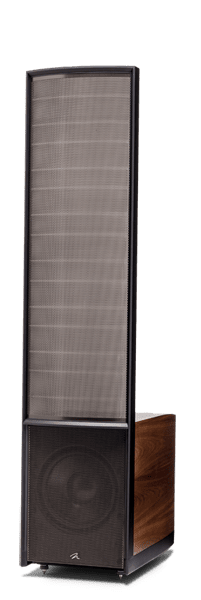
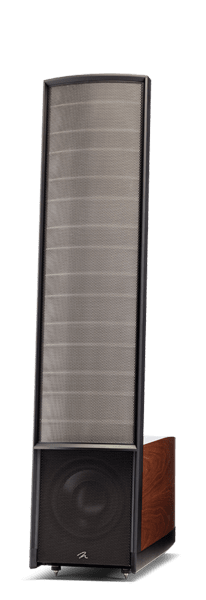
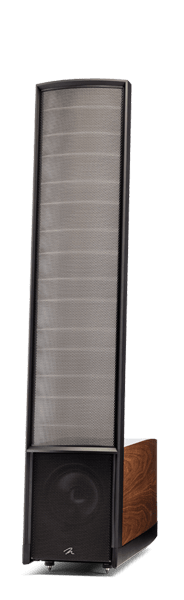
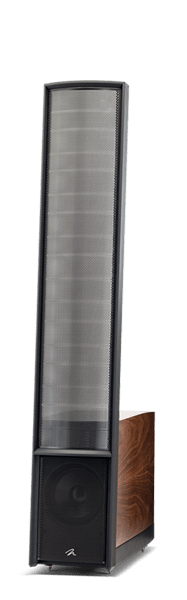
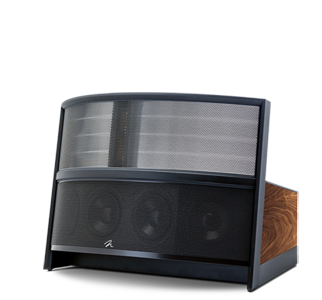
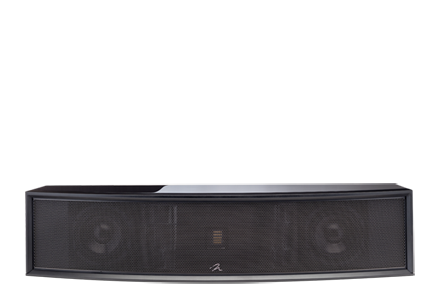
The Masterpiece Series is the electrostatic-hybrid line — the loudspeakers most people mean when they say Martin Logan. Neolith is the flagship, standing over six feet tall and made to order in Lawrence, with a large XStat electrostatic panel, a rear-firing 12-inch woofer, and a front-firing 15-inch woofer for the lowest octave. It reaches 23 Hz to 22 kHz within 3 dB, presents a nominal 4-ohm impedance dropping to 0.43 ohms at 20 kHz, and rewards amplification anywhere between 20 and 1,300 watts a channel. Below Neolith the Masterpiece line runs Renaissance ESL 15A, Expression ESL 13A, Impression ESL 11A, and Classic ESL 9 — progressively smaller electrostatic panels with correspondingly scaled bass modules. The Focus ESL C18 and Illusion ESL C34A are the dedicated centre channels, engineered to tonally match the floor-standers rather than adapted from a bookshelf design.
The Motion XT Series brings the Folded Motion XT tweeter and Nomex-reinforced Kevlar midrange down into a conventional dynamic cabinet — a purely dynamic floor-standing and bookshelf range for rooms and budgets where a full electrostatic is not the right answer. Motion XT F200, F100, B100 and C100 form the current tier. The Motion and Foundation ranges continue the dynamic line at smaller scale, and are typically specified into multi-room and secondary-system installations.
Martin Logan in the Scottsdale showroom and in Tempe
Neolith is on demonstration in the Scottsdale showroom. Hearing it is the entire argument for what Martin Logan does at the reference tier — a full-size XStat electrostatic panel driven as one continuous surface, mated to two dynamic woofers voiced against it, in a room built specifically for the loudspeaker rather than a loudspeaker sitting in a room that already existed. Bring music you know intimately: the string trio you have heard live, the voice recorded close to the microphone, the piano decay you can hear the room around. Neolith gives you those things back with a directness that dynamic loudspeakers work hard to approximate.
Additional Martin Logan models are on demonstration at the Tempe showroom, where the conversation shifts to specifying an electrostatic into a real room at a real scale — the Impression ESL 11A or Classic ESL 9 into a listening space that is not purpose-built, or the Motion XT range into a system where a full electrostatic is not the right answer. That is the more common conversation, and it is the one the Tempe demonstration setup supports directly.
LMC as a Martin Logan dealer since 2010
LMC has been an authorised Martin Logan dealer for fifteen years. What that time has taught the staff is the specific setup discipline an electrostatic asks for that a dynamic loudspeaker does not. Electrostatics are dipoles — they radiate equally forward and backward — so the wall behind them is not incidental. They present unusually low impedances at high frequencies (Neolith drops to 0.43 ohms at 20 kHz), which means the amplifier must be genuinely stable into low impedance rather than merely rated to handle it. And the hybrid crossover to the dynamic woofer is exquisitely sensitive to placement, because the panel’s low-frequency roll-off changes with distance from the front wall and the woofer’s crossover point must be tuned against the room, not the anechoic measurement.
None of those setup requirements is a shortcut a spec-sheet purchase can navigate. The Martin Logan specification conversation at LMC begins with the room drawings, the amplifier options, and the neighbouring loudspeakers the client is likely to compare against. It resolves on site, not in the showroom, and the fifteen years of Martin Logan installation experience is the value the dealer relationship delivers beyond the loudspeaker itself.
Where to start
The clearest first Martin Logan audition is the Neolith in the Scottsdale showroom. Full-scale electrostatic loudspeakers reward familiar music more than unfamiliar recordings — the surprise is not in what the loudspeaker adds but in what it does not do to what you already know. Bring a solo piano recording you have listened to for years, a small-ensemble jazz track with an upright bass, and a vocal recording with the microphone close in. Sit at the intended listening distance and listen through a full track without moving. The Neolith reveals itself over the course of the recording, not in the first ten seconds.
For an audition of the electrostatic principle in a more room-friendly package, the Tempe showroom is the right conversation — an Impression ESL 11A or Classic ESL 9 in a listening space closer to what most clients will actually build the loudspeakers into. For the Motion XT line and dynamic options, the same demonstration setup covers them.
What to listen for
Two tests deliberately reveal what an electrostatic does that a dynamic loudspeaker cannot. First, listen to a solo instrument you can name every note of — a violin, a solo piano, an acoustic guitar. Pay attention to the leading edge of each note and to the tail of the decay. The absence of cone momentum means the diaphragm starts moving exactly when the signal starts and stops exactly when the signal stops. On a dynamic loudspeaker there is always a small residual — a subtle overhang, a slight thickening on complex passages — that the electrostatic simply does not add. Once you hear the absence of it, you cannot un-hear it.
Second, listen to a vocal recording with sibilants and consonants in front of a busy backing. On a dynamic loudspeaker the vocal often sits somewhere on top of the mix, distinguishable but not clearly separated. On a properly set up electrostatic the singer moves forward into their own acoustic space, with the backing behind and around them. It is the imaging characteristic Martin Logan owners describe as the loudspeaker disappearing, and it is the reason electrostatic listeners tolerate the setup discipline the design requires.
Walk in during business hours or book ahead if the audition needs the Scottsdale Neolith room or Tempe Martin Logan demonstration configured for extended listening.
The Lineup
Explore the Range
Experience The Brand