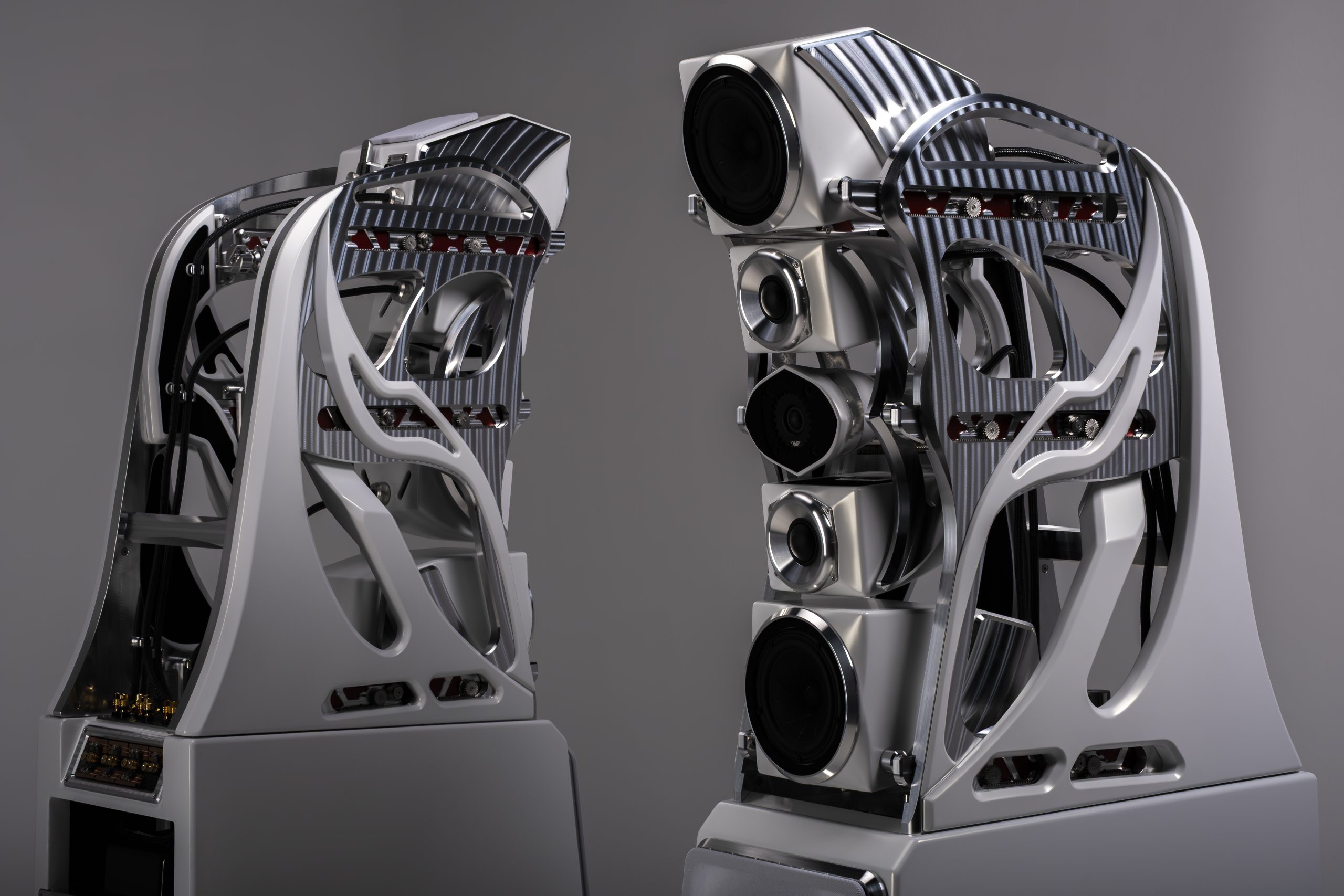
An autobiography is a personal chronicle. It is a record of lived experience shaped by time, intention, discovery, exploration, and refinement. It is a memoir—not simply of events, but of evolution. In that spirit, the Wilson Audio Autobiography stands as a sculpted narrative of the company’s history, its pursuit of musical truth, and its dedication to refinement in craftsmanship. Not just a personal chronicle, but a personnel chronicle.
Autobiography is the culmination of over half a century of education and uncompromising execution by the world’s most dedicated guild of loudspeaker craftspeople. Every element, every curve, and every acoustic decision reflects a journey that began with Wilson Audio’s founder, David A. Wilson, and his earliest experiments into time alignment, resonance control, and emotional connection with music. This loudspeaker does not reference the past as nostalgia. It distills experience into clarity, preserving what matters while advancing what is possible.
This paradigm-shifting design journals the path Wilson Audio has traveled, from the earliest original WAMM and WATT experiments to a forward-looking statement that could only exist today. Autobiography is not a compilation of prior solutions. It is the result of understanding why those solutions succeeded, and how they could be refined, reimagined, and elevated. This is Wilson Audio’s story told through engineering, through waves of music—a memoir of memory, rendered in sound.
Transducers — Crafted Anew
At the core of Autobiography lies a completely new driver complement. This is a five-way loudspeaker configured in an M(MTM)M array, with every transducer making its first appearance in this system. Each driver was conceived specifically for Autobiography—not developed as an isolated component, but as part of a unified acoustic architecture.
The vertical arrangement consists of a 7-inch midrange at the top and bottom of the gantry, followed by a symmetrical MTM crescent-framed array composed of dual 2-inch midrange drivers flanking the CSLS front-firing tweeter. Low frequencies are handled by two dissimilar woofers—a 12-inch unit and a 15-inch unit—developed exclusively to operate together. Completing the lineup is a rear-firing ambient tweeter designed to enrich spatial information.
Front-Firing Tweeter (CSLS): The Convergent Synergy Laser Sintered front-firing tweeter represents the latest evolution of Wilson Audio’s Convergent Synergy technology. Its redesigned rear-wave chamber improves energy dissipation, reduces internal reflections, and further lowers the noise floor—enhancing clarity without introducing grit or exaggeration.
2-inch Midrange (2-inch MID): Flanking the CSLS tweeter are two newly developed 2-inch Midband Integration Drivers, created to bridge the speed of the tweeter and the lush presentation of the larger midrange drivers. Their placement ensures symmetrical dispersion and precise time-alignment through the most perceptually sensitive region of human hearing.
7-inch Midrange (PentaMag): Above and below the MTM assembly sit two 7-inch PentaMag midrange drivers—a direct evolution of the QuadraMag platform, now employing five AlNiCo magnets arranged to produce greater motor strength, improved flux stability, and enhanced linearity under dynamic load.
Rear-Firing Tweeter (RFT): An inverted-dome rear-firing tweeter enhances spatial depth, ambient retrieval, and harmonic decay. Constructed from aerospace-grade unidirectional carbon fiber, it operates from 6 kHz to 22 kHz with an integrated attenuation control from 0 dB to −40 dB, enabling precise tailoring to room acoustics and listener preference.
Woofers — A Deeper Voice
The low-frequency architecture was driven by an inspiring objective: to deliver bass that is immediate, articulate, and authoritative while preserving tonal nuance and musical realism. To achieve this, two entirely new woofers of differing dimensions—a 12-inch unit and a 15-inch unit—were conceived in parallel and engineered as a unified system, while the entire woofer enclosure architecture was reshaped.
Designing dissimilar drivers to function as one coherent voice presents significant challenges in timing, pressure loading, and harmonic consistency. In Autobiography, those challenges were addressed through purpose-built motor structures, suspension geometries, and a heroically built enclosure. Together, the two woofers form a seamless low-frequency foundation that responds with speed, control, and scale—powerful without excess, extended without sacrificing emotional impact.
Hardware — Precision in Each Element
Autobiography employs bespoke hardware designed specifically for this system—an evolution in how modules are mechanically time-aligned. From the module alignment sleds to the precision slide spikes, each component is engineered to function seamlessly with the others. Both PentaMag midrange modules are independently adjustable via the module alignment sled system, and the MTM crescent frame is similarly equipped, enabling time-domain precision that exceeds both the WAMM Master Chronosonic and the Chronosonic XVX.
New tool-free port hardware enables rapid configuration changes and room integration. The cross-load flow porting system allows controlled adjustment of low-frequency interaction with the room: in a forward-firing configuration, output in the 10–75 Hz region is reduced by roughly 1.0–1.5 dB while output between 75–130 Hz increases by 1.5–2.0 dB, with the rear-firing configuration giving the inverse response.
Materials — Engineered Elegance
There is no single material that functions optimally in all acoustic and structural applications. Autobiography reflects this through a richly layered architecture of purposefully engineered materials—high-density phenolic resin composites (H-Material and constrained-layer V- and X-Materials), carbon fiber, aerospace-grade aluminum, stainless steel, copper, and gold—each selected for specific mechanical and sonic properties. Their refined application defines how energy is controlled, directed, dissipated, and ultimately rendered as music.
The crossover housing is constructed from woven carbon fiber and mounted to a V-Material vibration sink, tied together by dual metal cross-braces. Every enclosure and module interface incorporates V-Material, and a new version was developed for the entire bottom of the woofer enclosure to increase vibration control at the interface with Wilson Audio’s Acoustic Diodes. At its tallest configuration, Autobiography stands approximately 83.5 inches tall.
Crossovers — Musically Minded
Autobiography employs handcrafted, point-to-point, in-house-built crossovers. The multi-section Reliable Capacitors (Rel-Cap) used throughout are manufactured at Wilson Audio on custom-built machines and finished by hand to within ±0.2% of specification—the most musically revealing capacitors Wilson Audio has ever produced. Unique copper variants of the AudioCapX-WA capacitor refine high-frequency micro-detail and reveal subtle spatial cues, while a newly configured woofer capacitor ensures low-frequency information integrates seamlessly with the midrange. Each component is fabricated at Wilson Audio or individually selected, oriented, and hand-soldered without the use of printed circuit boards.
This is not a revision. It is Wilson Audio’s definitive statement—and LMC is one of a small handful of dealers worldwide chosen to present it.